One child might not be able to stand still for even a minute, climbs all over the playground, and loves to compete. Another is more cautious, withdraws during conflicts, or needs a structured environment. So when it comes to the question, “At what age can children start training in martial arts?” it’s not just about a number on their ID. What matters most are maturity, a love of movement, a safe training environment, and coaches who can truly guide children.
Martial arts can offer children many benefits: body awareness, concentration, self-confidence, and the ability to treat others with respect. However, it is not a crash course in toughness, nor is it a solution if a child is sent to training against their will. Good martial arts begin with attitude—both in training and outside the dojo.
At What Age Is Martial Arts Appropriate for Children?
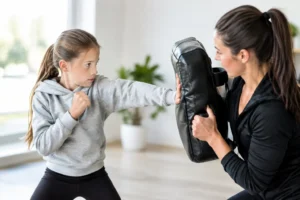
Many children can begin age-appropriate martial arts training starting around age 5. At this age, they primarily learn basic movements: how to fall safely, balance, jump, turn, respond to signals, and control their own bodies. Complex techniques, hard strikes, or free sparring are not part of the initial training phase.
Starting in elementary school, children are usually better able to follow rules, perform partner exercises with greater focus, and stay engaged in a task for a longer period of time. Nevertheless, every child is different. A lively six-year-old may be very well suited to the right class, while an eight-year-old may still need some time at first to feel comfortable with group rules or physical contact.
Age, then, is a guideline, not an entrance exam. Parents should ask themselves less, “Is my child tough enough yet?” The better question is, “Can my child enjoy learning, listening, and practicing respectfully with others?”
How Parents Can Tell If Their Child Is Ready for Sports
A child doesn’t need to be particularly athletic or brave before their first practice. However, it helps if they can understand simple instructions, focus on an exercise for a short time, and accept that other children need space, too. Equally important is their willingness to take “stop” signals seriously.
Shyness is not an obstacle. In fact, reserved children often benefit from learning to act with more confidence at their own pace. Even having a lot of energy is not a reason to rule it out. What matters is whether that energy can be channeled—with clear guidance—into movement, attentiveness, and consideration.
If a child seems exhausted but happy after a trial practice, talks about an exercise, or wants to come back for the next session, that’s usually a better sign than any athletic achievement. Motivation grows from positive experiences, not from pressure.
What Kids Really Learn in Martial Arts
Martial arts for children aren’t about being better than others. Through good training, children learn to assess their strength and take responsibility for it. They learn that a controlled step back is sometimes more powerful than a strike forward.
The physical progress is evident: coordination, flexibility, endurance, and balance improve with every training session. For many children, it is especially valuable that they not only experience their bodies while running or playing, but also learn to use them in a purposeful way. Good posture, a steady stance, and mindful breathing often change the way they carry themselves in everyday life as well.
Then there’s the mental aspect. Repetition fosters patience. Techniques don’t always work right away. Those who keep practicing, persevere through minor setbacks, and notice improvements develop confidence in their own ability to learn. This feeling carries over into school, friendships, and difficult situations.
Respect isn’t just a cliché said before practice begins. Children learn not to treat their partner as an opponent, but as someone with whom they can practice safely. They wait their turn, listen, help one another, and follow the rules. Tradition meets modernity when such values are combined with contemporary training methods.
Not every martial art is right for every child
Whether it’s kung fu, Wing Chun, boxing, kickboxing, wrestling, grappling, or a child-friendly mix: The name alone says little about the quality of a class. What matters much more is how the training is conducted. A good children’s class differs significantly from adult classes—and not just because of smaller gloves or shorter sessions.
For younger children, the focus is on playful movement activities, coordination, and clear routines. Traditional forms can promote concentration and body control, while simple partner drills teach spatial awareness and consideration. Ring and grappling elements help children understand proximity, balance, and controlled falls. Striking techniques require rules, appropriate targets, and proper control from the very beginning.
As children get older, training can become more challenging. Teenagers can deepen their understanding of technique, conditioning, self-defense, and—depending on their interests—exercises that are more competition-oriented. Physical contact is not inherently bad. However, it must be introduced gradually, clearly supervised, and adapted to the student’s level of development. Uncontrolled striking, pressure to perform, and the glorification of violence have no place in children’s training.
Safety starts with the group
During their first visit, parents shouldn’t just focus on the facilities. Mats, safety equipment, and clean rooms are important, but they are no substitute for responsible care. Observe how the staff handles mistakes, whether rules are explained clearly, and whether quieter children are also given attention.
A reasonable group size allows for corrections and individual attention. Children need clear routines: greeting, warm-up, technique, partner exercises, and wrap-up. This structure provides a sense of security and helps them stay focused. Coaches should not only be technically experienced but also understand how children learn, set boundaries, and manage conflicts within a group.
Also, make sure to take a clear stance on the topic of self-defense. Children should learn to recognize danger early on, create distance, call out for help, and confide in adults. Physical techniques are only part of it. Self-defense means, first and foremost, getting out of situations as safely as possible.
How often should children exercise?
To start out, one scheduled session per week is usually enough. Children need time to process new experiences, and in addition to training, they should continue to play freely, rest, and pursue other interests. Consistency is more important than a packed weekly schedule.
After a few months, it becomes clear whether the child wants to do more. Some look forward to a second session, while others stick with just one session over the long term. Both are fine. Progress isn’t achieved by having children do as much as possible as early as possible, but through consistent practice that fits into their daily lives.
Parents can offer support without being controlling. Ask about the best part of the session instead of focusing on perfect technique. Praise effort, attention, and fairness. A lost game, a failed drill, or a tough day of practice are all part of the learning process.
When It’s a Good Idea to Take a Break or Make a Change
Not every instance of feeling unwell means that martial arts are fundamentally unsuitable. The first few weeks, in particular, can feel unfamiliar: new rules, unfamiliar children, physical closeness, and a different rhythm of movement. An open conversation with the coaching staff can help address any concerns and find solutions.
However, if a child shows signs of significant anxiety over an extended period, feels pressured, or is regularly expected to ignore pain, a change is needed. This could mean taking a break, joining a different group, or trying a different type of training. The focus should be on the child—not the schedule and not the adults’ competitive ambitions.
It’s also a good idea to discuss any existing injuries, developmental differences, or health concerns. Good coaches adapt exercises without excluding the child. If there are any medical concerns, you should also seek medical advice.
The Right Way to Get Started in Berlin
A trial class reveals more than any course description ever could. Children get a feel for the atmosphere, get to know the group, and see if they’re free to move around, try things out, and ask questions. At the same time, parents can see if the program’s standards and level of care are a good fit.
At Berlin Siu Lam Wing Chun Pai & SLWCP Fight Academy, the focus is on an age-appropriate training program: martial arts tradition, modern training methods, and clear rules for safe interaction. Children don’t have to prove that they already know how to do something. They’re free to start, learn, and gain confidence with every training session.
Give your child the chance to take that first step on their own. Not so they have to struggle, but so they can learn to stand on their own two feet, respect boundaries, and participate in life with respect.