A guide to self-defense for children doesn’t start with a punch and doesn’t end with a technique. Above all, children need the confidence to trust their instincts, set clear boundaries, and seek help in time. Good self-defense means: recognizing danger, creating distance, raising your voice, running away, and involving adults.
Children’s self-defense begins before the first grab
Children rarely find themselves in situations that feel like a sparring match in training. Much more often, it’s about a mean remark in the schoolyard, a child who keeps pushing even after being told to stop, a stranger making an annoying request, or an argument that suddenly turns physical. That’s why self-defense must be relevant to everyday life.
The goal is not to train children to be little fighters who resolve conflicts physically. Quite the opposite: They should learn when they don’t need to argue, when they can say “no” clearly, and when the best course of action is to seek refuge with people they trust. Courage isn’t about standing your ground. Courage is about acting wisely.
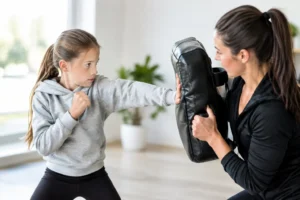
A good training session combines movement, voice, awareness, and posture. Children learn that they are allowed to take up space. They practice standing firmly, maintaining an alert gaze, and using a voice that is heard. These skills are also helpful outside of dangerous situations: when setting personal boundaries, dealing with peer pressure, and presenting themselves with confidence at school and during leisure time.
What Children Should Really Learn
Self-defense for children must be age-appropriate, simple, and easy to repeat. Complicated sequences don’t work under stress. Therefore, to ensure that the techniques are reliably mastered, they are taught using clear rules and plenty of practical exercises.
The key fundamentals can be summarized in four steps:
- Be aware: What feels off? Who is getting too close to me? Where can I find help?
- Setting Boundaries: A clear “Stop!”, “No!”, or “Don’t do that!” isn’t rude when a boundary has been crossed.
- Creating distance: Children learn to move sideways, hold their hands in front of their bodies for protection, and find a way around other people.
- Get help: Run away, shout for help, and tell a trusted adult what happened.
The fourth point is particularly crucial. Many children think they have to solve a problem on their own or that they aren’t allowed to say anything because they’ve been threatened. They need a clear message here: Secrets that cause fear are not secrets that need to be kept. It’s right to seek help.
Clear boundaries require clear language
A child doesn’t have to first politely explain why they don’t want to be touched. If someone gets too close, holds them, insults them, or pressures them into something, their reaction should be clear. During training, this may seem unusual at first. Children often speak softly, laugh out of insecurity, or look at the floor. This isn’t a mistake—it’s a starting point.
Through role-playing, they learn to use their voices consciously. A loud “Stop!” grabs attention and can buy you a moment to create some distance. The key is the combination of voice and body posture: feet planted firmly, eyes looking straight ahead, hands in front of the torso. This posture isn’t aggressive. It signals: This far and no further.
Context matters here. When playing with friends, a quick “Stop” may be enough. In cases of repeated teasing, bullying, or physical assault, adults must be informed. Self-defense does not replace the responsibility of the school, parents, or caregivers. However, it gives children the words and options for action so they are not left speechless.
Physical Liberation: Simple, Safe, and Targeted
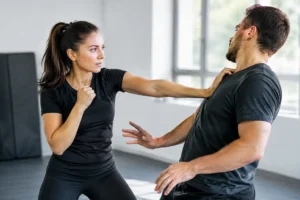
There are situations in which a child is being held and cannot get away immediately. In such cases, the child is allowed to free themselves. Children don’t need any spectacular techniques to do this—just simple movements that suit their bodies: shifting their weight, turning toward an open space, breaking the hold, creating distance, and running away immediately.
During practice, this is practiced in a controlled and respectful manner. No one is intimidated or intentionally overwhelmed. Younger children, in particular, benefit from working with clear rules: There is a stop signal, partners look out for one another, and after each exercise, they discuss what went well.
The order is also important: First, prevent; then, resolve; then, move on. Physical force is not a means of winning an argument or punishing someone. It serves only to free oneself from an immediate threat. This boundary instills discipline and prevents self-defense from being confused with violence.
Self-confidence grows through repeated practice
A single workshop can provide valuable inspiration. However, lasting safety comes from regular practice. Children develop coordination, reaction time, and body control not through theory, but by practicing, making mistakes, and seeing their progress.
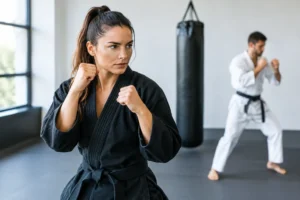
Traditional martial arts can provide a strong framework for this. Respect for training partners, concentration, controlled movement, and binding rules are no trivial matter. They create a culture in which children can test their limits without belittling others. Modern elements from boxing, kickboxing, grappling, or practical self-defense complement this framework wherever they are useful for establishing distance, movement, and escape.
At Berlin Siu Lam Wing Chun Pai & SLWCP Fight Academy, the focus is therefore not just on a single technique. Children develop body awareness, focus, perseverance, and respectful interaction. Tradition meets modernity, but the individual is always at the center. A shy child may first need to build trust within the group. A very impulsive child may need more practice in maintaining self-control. Both are integral parts of a responsible training program.
How Parents Can Provide Meaningful Support at Home
Parents don’t need to turn their home into a training room. Short, calm conversations and small exercises as part of daily life are much more effective. For example, ask your child: “What would you do if someone kept going even after you said ‘stop’?” or “Which adults can you go to if you need help?” Together, you can identify safe places along the way to school and agree on a family code word that your child can use on the phone to signal that they need help.
Be careful not to raise your children through fear. Statements like “Never talk to strangers” are too broad and aren’t very helpful in a real emergency. Children need guidance rather than mistrust of everyone. A better approach is: “You must never go with anyone, not even someone who seems friendly or claims to know us. If you’re unsure, go to someone in uniform, into a store, to a family, or shout for help.”
Equally important: Take reports seriously. If a child tells you that they were teased, harassed, or touched, they shouldn’t have to prove first that the situation was “bad enough.” Listen, ask questions, reassure them, and, if necessary, involve the school, a club, or other appropriate authorities—this shows the child that their boundaries matter.
Different age groups, different areas of focus
Preschoolers learn primarily through movement, simple rules, and clear concepts. “Say ‘stop,’” “walk away,” and “get help” are the key messages here. In elementary school, children can also practice better assessing conflicts, recognizing peer pressure, and freeing themselves from simple situations where they are being held.
For teenagers, the issues change. They become more independent on their way to school, social conflicts become more complex, and digital communication comes into play. Self-defense then also includes de-escalation, body language, avoiding risky situations, and dealing responsibly with provocations. Those who can stand their ground don’t have to react to every challenge.
It always depends on the child. Height, temperament, prior experience, and personal needs all play a role. Effective training doesn’t rely on rigid expectations but supports development step by step.
The right setting makes all the difference
When choosing a children’s class, parents should make sure that safety is visibly prioritized. This includes qualified instructors, age-appropriate groups, clear rules, respectful communication, and exercises without unnecessary pressure to perform. Children should be challenged, but they must not be shamed.
A trial class can show whether the atmosphere is a good fit. Does the child feel welcome? Are the rules explained clearly? Is the training focused, yet does it also allow room for fun? Self-defense is effective when children enjoy coming back and realize: My effort matters, I can learn, and I’m part of a community that looks out for one another.
Give your child permission to be clear, to step back, and to ask for help. At the crucial moment, this permission can be more powerful than any single technique.