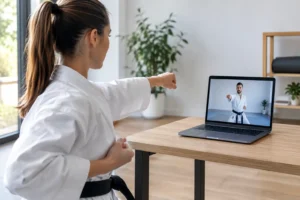
There’s not much time after work, and the trip to practice is sometimes too far—but your commitment to quality martial arts training remains. That’s why online martial arts training isn’t an excuse to train less. When structured properly, it becomes a valuable supplement: for solid fundamentals, better conditioning, greater body awareness, and focused work on the details that often get overlooked in regular training.
What matters isn’t whether a workout starts on the mat, at the gym, or in front of a screen. What matters is whether you stay focused, receive clear corrections, and regularly review what you’ve learned. Tradition meets modernity here, too: discipline, respect, and repetition remain the foundation. Video lessons and personalized feedback make them applicable to your everyday life.
What Online Martial Arts Can Do—and What It Can’t
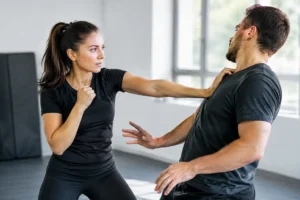
Martial arts are about interaction. Distance, timing, pressure, and reaction cannot be fully learned on your own in the living room. Anyone who wants to train in sparring, clinching, grappling, or realistic self-defense needs training partners, qualified instruction, and a safe training environment. In-person training remains essential for this.
Online training, however, has its own strength: it creates space for deliberate repetition. Without the pressure to keep up with the group right away, you can perform a movement slowly ten times, check your form, and feel the difference between strength and structure. Beginners, in particular, benefit from this. Advanced practitioners use this time to more precisely refine their footwork, striking mechanics, forms, mobility, or athleticism.
So the value isn’t in replacing the dojo or the academy. It’s in making your training more intensive. A good online session complements in-person instruction rather than running parallel to it.
Technology starts with a clear task
A video showing lots of fast combinations looks motivating. But motivation alone isn’t enough for sustained progress. A meaningful training session needs a clear goal: Today you’ll work on your stance. Tomorrow, on hip rotation. The next session will focus on blocking and returning to a stable position.
This applies to Wing Chun Kung Fu just as much as it does to boxing or kickboxing. For example, when practicing a straight punch, you shouldn’t just focus on your fist. How are your feet positioned? Is your knee stable? Are your hips rotating with the movement? Is your shoulder relaxed? Is your hand returning in a controlled manner? These questions are what turn a movement into a technique.
This is especially important online because no one is standing right next to you to correct your form. So work at a slower pace than your ambition might demand. Speed will come later. A solid foundation is the basis on which speed, power, and confidence grow.
Video feedback fosters commitment
Recording a training video can feel a bit strange at first. But it’s an honest reflection of your form. You can see if your guard drops when you punch, if you lose your balance when you kick, or if your steps are too big. The coaching staff can pick up right where a general lesson leaves off.
In the Vade Mecum Martial Arts Academy’s English-language online program, this feedback is an integral part of the training process. You don’t just work your way through a playlist. You demonstrate your commitment, receive specific guidance, and apply it in the next session. This creates a cycle of practicing, evaluating, correcting, and practicing again.
This requires personal responsibility. At the same time, it protects you from a common mistake in digital training: simply imitating movements without understanding why they work. Your effort counts, but precise guidance is what determines whether you make meaningful progress.
Here’s How to Build an Effective Workout Routine
You don’t need a perfectly equipped workout space. Two or three clear steps, a non-slip floor, comfortable workout clothes, and a camera or smartphone are enough for many workouts. If you have a sandbag, focus mitts, or resistance bands, you can add them later if it makes sense. When you’re just starting out, less is often better because you’ll be focusing on your body mechanics.
Schedule fixed workout times as if they were appointments at the gym. Two focused sessions of 30 to 45 minutes per week are more effective than one overambitious Sunday workout followed by a ten-day break. If possible, supplement them with in-person training. This way, you can combine individual repetitions with partner work and a real sense of community.
A good session starts with mobility exercises and a short warm-up. This is followed by a technical exercise, such as footwork with blocking or a simple punch combination. Only once the movement remains controlled should you increase the duration or intensity. To wrap things up, loose movements, breathing exercises, and brief notes are helpful: What worked today? Where did you lose your balance? What adjustments will you make for the next session?
Anyone working with children or teenagers should keep the goals even simpler. Enjoying physical activity, concentration, coordination, and respectful interaction take precedence over complicated routines. Adults should not try to copy training programs for young people exactly. Age-appropriate training is not an extra—it’s a matter of safety and good teaching practices.
Fitness is a means to an end, not an end in itself
Online martial arts can really challenge you: shadowboxing, squats, push-ups, core exercises, jumping exercises, and interval training improve your stamina and endurance. But martial arts fitness is about more than just pushing yourself to the point of exhaustion. It’s meant to help you stay stable under pressure, breathe clearly, and execute techniques with control.
That’s why intense physical training shouldn’t dominate every session. After a technically demanding day, a session focused on flexibility, qigong, balance, or controlled shadow boxing can be more valuable than another hundred repetitions until you’re completely exhausted. Progress comes from a balance of effort and recovery, not from constantly pushing yourself too hard.
Pay attention to warning signs. Sharp pains, persistent discomfort, or dizziness are not something you should just power through. Adjust your exercises, reduce the intensity, and seek professional advice if needed. Part of professional training is taking your limits seriously.
Self-defense requires a sense of reality
Many people start training in martial arts because they want to feel safer. That’s a valid goal. Online, you can practice basics such as posture, spatial awareness, speaking loudly and clearly, agility, and quickly getting out of a dangerous situation. You can also practice mental preparation: staying alert, setting boundaries, and remaining capable of acting under stress.
Nevertheless, it would be irresponsible to promise self-defense exclusively through a screen. Escapes, contact techniques, de-escalation under pressure, and dealing with unpredictable situations require in-person training, partner drills, and experienced supervision. Good self-defense is not a repertoire of tricks. It begins with awareness, avoids unnecessary risks, and uses physical force only when there is no safe alternative.
It is precisely this level-headedness that boosts your self-confidence. You’re not training for a movie scene, but to improve your attitude in everyday life: to be alert, capable, and responsible.
A sense of community also develops among the units
Training on your own doesn’t mean learning on your own. When you submit videos, ask questions, and act on feedback, you remain part of a shared journey. Others might train before work, after college, or in between family life and shift work. Circumstances may vary, but our dedication brings us together.
So don’t use online training as a silent substitute, but rather as an active supplement. Bring your questions to in-person training sessions. Take the corrections you receive at the gym home with you. Share your progress without feeling the need to compare yourself to others. Martial arts thrive on respect, and respect is also shown by remaining patient with your own learning process.
If you don’t have much time today, start with a simple task: ten minutes of stable posture, mindful breathing, and precise movements in front of the mirror. Consistency beats perfection. Get into the flow, stay focused, and give each repetition the quality you’ll need later when the pressure is on.