Most of the time, a teenager isn’t on the training floor because they want to fight. Often, it’s about feeling more confident, channeling energy in a meaningful way, clearing their head, or finally finding a sport that demands more than just going through the motions. Martial arts for teens in Berlin can create exactly this kind of space—provided that the training, the coaching staff, and the group are truly a good fit.
A lot changes during adolescence: the body, self-image, friendships, and the pressure to perform. Good martial arts training takes this phase seriously. It demands commitment, but it doesn’t embarrass anyone. It teaches clear rules without being rigid. And it shows young people that strength isn’t about putting others down, but about being able to control oneself.
What Martial Arts Actually Offer Teenagers
Martial arts are not a crash course in self-confidence. Progress comes through repetition: building a stance correctly, better gauging distance, executing a technique under pressure, and continuing to train after making a mistake. That is precisely where its value lies. Young people experience firsthand that their effort makes a difference.
Physically, regular training improves coordination, flexibility, strength, endurance, and reaction time. People who box, kick, wrestle, or practice martial arts gain a more precise understanding of their own bodies. This helps not only during training but often in everyday life as well—in carrying oneself with confidence, concentrating in school, and managing stress.
The mental aspect is just as crucial. Young people learn not to take criticism as a personal attack, but rather as concrete guidance for the next step. They practice patience, commitment, and tolerance for frustration. Not every technique works right away. Not every practice session feels easy. But those who stick with it realize: I can learn something that was difficult at first.
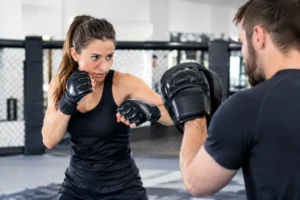
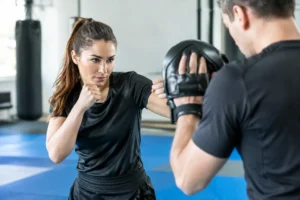
The group itself is also important. In a good training community, different personalities, experiences, and skill levels come together. Respect isn’t just talked about—it’s put into practice—during partner drills, while holding pads, during controlled sparring, and in how we handle both defeats and victories.
Martial Arts for Teens in Berlin: What Parents Should Keep in Mind
Berlin offers many martial arts programs. However, the differences aren’t limited to the styles alone. For young people, the teaching method is what matters most. A school can be technically challenging while still being a safe place with a clear educational approach. The two go hand in hand.
When forming your first impression, pay attention to whether the young people are truly being actively supervised. Are the exercises explained clearly? Do the coaches provide attentive corrections? Are there clear rules regarding physical contact and sparring? And is the atmosphere focused, without coming across as unnecessarily harsh or intimidating?
A good youth training program does not make a blanket distinction between “talented” and “untalented.” Some young people bring a lot of energy to the program, while others are reserved at first. Some want to compete later on, while others are looking for fitness and self-defense. Professional guidance creates challenges that allow both groups to grow.
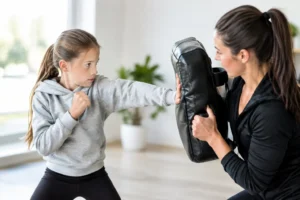
Equally important is age-appropriateness. Teenagers don’t need a simplified children’s program, but neither do they need an unsupervised adult group. Exercises, intensity, and partner pairings must be appropriate for their physical development and level of experience. This is especially true in sparring: control comes before intensity. Those who simply rack up hits learn little. Those who practice distance, timing, defense, and consideration develop true combat skills.
Tradition Meets Modernity in the Training Area
A well-rounded education doesn’t have to lock young people into a single path early on. Traditional Wing Chun and Shaolin Kung Fu can help develop physical structure, movement quality, concentration, and an understanding of distance. Boxing and kickboxing promote precise punching and footwork, rhythm, and endurance. Grappling teaches control in close quarters, balance, and how to handle physical contact responsibly.
MMA-oriented training can integrate these areas when it is conducted systematically and safely. This does not mean that teenagers have to engage in full-contact fighting right away. On the contrary: the basics come first. Movements are practiced in isolation, partner drills are clearly defined, and intensity is built up step by step.
Practical self-defense is a valuable addition to training. It’s not about spectacular tricks or false promises. Young people should learn to recognize situations early on, clearly communicate their boundaries, create distance, and get help. The best self-defense is often the kind that prevents a fight from happening in the first place. When physical action becomes necessary, simple, realistically practiced principles are more important than complicated sequences.
At Berlin Siu Lam Wing Chun Pai & SLWCP Fight Academy, this breadth is combined with a clear philosophy: the individual is at the center. Young people should not just imitate techniques, but understand what they are training and why. Tradition provides the foundation and depth, while modern martial arts methods give the training directness and practical, verifiable application.
How a Good First Training Session Goes
Many teenagers come to the trial session with mixed feelings. Some want to jump right in, while others prefer to watch for a while first. Both reactions are normal. A good first session allows time for participants to settle in while still getting them moving quickly.
The session usually begins with warm-ups, coordination exercises, and basic movements. This is followed by technical exercises, such as strike combinations using focus mitts, footwork sequences, simple escapes, or controlled partner drills. What matters isn’t how much someone already knows. What matters is whether they listen, give things a try, and are willing to engage with the group.
Teenagers should bring comfortable workout clothes, something to drink, and an open mind to the trial session. Special equipment is often not necessary for the first session. What they can expect is a structured workout where questions are welcome and mistakes are seen as part of the learning process.
Parents can then ask specific questions: Did my child feel safe? Were the rules explained clearly? Was the training challenging but manageable? Did my child want to come back? A positive first impression isn’t a substitute for long-term development, but it is a strong indicator.
Between Competitive Ambition and Personal Growth
Not every teenager wants to step into the ring, onto the mat, or compete in tournaments. And they don’t have to. Competition can provide valuable experiences: preparation, courage, fairness under pressure, and a healthy attitude toward winning and losing. For some, it becomes a powerful motivator.
For others, the reward lies elsewhere. They want to become more resilient, make friends during practice, or feel more confident in difficult situations. A good program accommodates both approaches. It challenges ambitious young athletes without leaving beginners behind. And it protects shy teenagers from having to prove themselves before they’ve built up confidence.
It’s important to maintain a realistic perspective: Martial arts won’t resolve every insecurity, and they are no substitute for professional help when dealing with serious stress. However, they can serve as a solid foundation. Regular exercise, clear goals, reliable support systems, and visible progress often have an impact far beyond the training hall.
The right time isn’t “someday”
Many families wait until a teenager “has more self-confidence,” “is in better shape,” or “knows exactly which path is right for them.” But training is where these things can develop. You don’t have to start out strong to get stronger. You just have to be willing to take that first step with commitment.
A trial session will quickly show whether the mix of discipline, exercise, and community is the right fit. Young people don’t need to start from a perfect place. They need an environment that takes them seriously, believes in them, and guides them along their journey with clear rules. Get involved—with respect, focus, and the courage to keep learning.