A clean punch is more than just power from the shoulder. It begins from a standing position, is transferred through the legs and hips, remains stable at the moment of impact, and immediately returns to a safe guard. This is exactly where Kung Fu boxing gets exciting: traditional martial arts principles meet the direct, measurable striking techniques of boxing.
For many people in Berlin, this combination is the right choice if they don’t want to have to choose between forms, fitness, and real-world combat training. They want to stay active, improve their focus, build self-confidence, and learn to remain capable of acting under pressure. Kung Fu boxing can combine all of these elements—provided it’s practiced in a structured, respectful manner with a clear focus on safety.
What Kung Fu Boxing Really Means
Kung Fu boxing is not a standardized style with a set of rules that is identical worldwide. Rather, the term describes a training method that combines Chinese martial arts with the punching techniques, footwork, and spacing of Western boxing. The emphasis placed on each of these elements depends on the school, the coaching staff, and the training goals.
Kung Fu involves more than just visual movements or traditional forms. Key principles include body structure, balance, timing, angle work, relaxation under stress, and an understanding of close-range combat. Systems such as Wing Chun, in particular, focus intensively on closing lines, detecting attacks early, and protecting one’s center.
Boxing provides a clear vocabulary for combat: jab, cross, hook, evasive movements, guard, changes in rhythm, and combinations. These techniques can be experienced firsthand during partner training. A hit honestly shows whether your distance, hand placement, and movement were effective. That doesn’t mean every training session has to be intense sparring. It means that technique shouldn’t just look good in the air.
Why the connection is so challenging
Those who train in Kung Fu boxing work with two different strengths. Traditional martial arts often teach how to organize the entire body as a single unit. Modern boxing methods, on the other hand, consistently focus on developing a sense of distance, footwork, and the ability to react to moving opponents. Taken together, this creates a versatile foundation—but only if the principles aren’t mixed together haphazardly.
A deep, static stance can be useful in structural training, for example. For dynamic boxing, however, it would often be too slow. A wide arm position may serve a tactical purpose in a specific exercise, but it can leave you vulnerable to fast punch combinations. Good training explains such differences rather than glossing over them.
The criterion is not whether a movement is old or new. The key factor is its context: What is the distance between the participants? Are there rules? Is anyone wearing gloves? Is it a sporting competition, self-defense, or a technical partner drill? Those who understand these questions not only practice more techniques but also make better decisions.
Structure Meets Footwork
In kung fu, structure is often developed through stance, joint alignment, and controlled force transfer. In boxing, you learn to maintain this stability while moving. The ground is not merely a surface to stand on. Every step determines whether a punch packs a punch, whether a dodge is successful, and whether you’re back on solid footing after a combination.
A good boxer does not move frantically. A good kung fu practitioner does not stand motionless. Kung fu boxing requires both: grounding when contact is made, and mobility when the distance changes.
Precision Over Hardness
Beginners often associate boxing with hard punches at first. But power without control leads to unnecessary injuries, poor movement patterns, and false confidence. Precision begins with a closed fist, a stable wrist, proper shoulder positioning, and a guard that doesn’t drop after the punch.
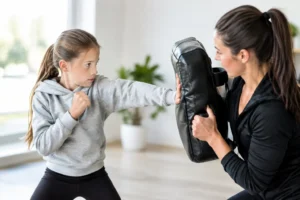
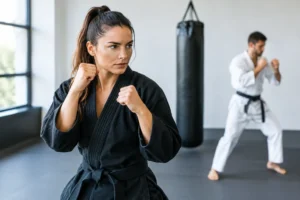
Punching pad work and sandbag training also serve different purposes. Punching pads help develop reaction time, combinations, and communication with a partner. The sandbag helps develop rhythm, endurance, and power transfer. The two complement each other but do not replace the calm, technical work on posture, breathing, and distance.
This Is What a Meaningful Kung Fu Boxing Workout Looks Like
A good training session doesn’t start with the toughest round, but with preparation. Mobility, joint stability, and an energizing warm-up lay the foundation for quick changes of direction and confident strikes. This is usually followed by technical exercises, first on your own and later with a partner.
The focus is on clear, repeatable tasks: maintaining proper stance, keeping distance, executing straight strikes, closing the guard, recognizing lines of attack, and not standing still after a move. Advanced practitioners combine these with angular footwork, counterattacks, close-range combat, and tactical decisions under time pressure.
For many ambitious trainees, sparring is a regular part of their training, but it is not a test of courage, nor is it a place for egos. Controlled sparring is a learning experience. The intensity, protective gear, and rules must be appropriate for the trainee’s level of experience. Beginners benefit most from light contact drills, clear instructions on how to attack, and partners who take responsibility.
A well-balanced unit can combine four areas:
- Basics such as stance, guard, punches, and footwork
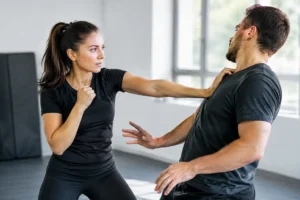
- Partner Drills for Timing, Distance, and Reaction
- Punching pads, sandbags, or circuit training for endurance and strength endurance
- Controlled use, tailored to experience and objectives
These building blocks make training varied, but not haphazard. Repetition is part of progress. Only when a straight strike remains steady even when tired, when the hands return after an attack, and when the gaze remains steady, does a movement become a reliable skill.
Self-Defense: Realistic Rather Than Dramatic
Kung Fu boxing can improve your self-defense skills, but it does not guarantee invincibility. Real-life conflicts are unpredictable. The terrain, confined spaces, surprises, and the presence of multiple people or objects can change any situation. Therefore, the best way to protect yourself starts with staying alert, communicating clearly, and being prepared to leave a situation early on.
Physical training remains valuable, however. Those who can judge distance, protect their hands, breathe while under stress, and execute precise movements are less likely to feel helpless. It’s not about looking for confrontations. It’s about recognizing boundaries, remaining capable of acting, and taking the protection of oneself and others seriously.
Self-defense also requires more than just striking techniques. It includes escaping from holds, handling close-range situations, getting back up after a fall, and managing stress. That’s why the Berlin Siu Lam Wing Chun Pai & SLWCP Fight Academy combines martial arts, boxing, grappling, and practical self-defense into a training program that focuses on the individual and their actual goals.
Who is Kung Fu boxing suitable for?
Adult beginners don’t need to be particularly flexible or have any prior martial arts experience. What matters most is regular training, patience, and a willingness to take the basics seriously. Those who just want to burn calories quickly will find this a challenging workout. However, those who stick with it usually discover more: better posture, stronger shoulders, improved concentration, and a calmer demeanor.
Advanced practitioners benefit from this integration when they are willing to reevaluate their habits. An experienced martial artist can refine their footwork. A boxer can gain new insights into close-range combat, structure, and angles. Progress doesn’t come from collecting as many systems as possible, but from thoroughly training the connections between them.
Different standards apply to teenagers and children. Here, age-appropriate exercises, coordination, self-assertion, and treating one another with respect are the top priorities. Controlled partner work can be very valuable, but it requires pedagogical guidance, clear boundaries, and an atmosphere in which no one feels the need to prove themselves. In this context, discipline does not mean strictness at any cost, but rather taking responsibility for one’s own actions.
Progress happens between training sessions
The most noticeable improvements rarely come from a single, particularly intense workout. They happen when exercise becomes a habit. Two focused workouts per week, enough sleep, and allowing your body time to recover usually yield better results than a brief burst of motivation followed by overexertion.
Set specific goals for yourself: lasting a full round with consistent defense, executing a combination with clean technique, or staying calmer during partner drills. Goals like these are measurable and give your training direction. Don’t just compare yourself to the most experienced people in the room. Your effort counts if you’re training more mindfully today than you were four weeks ago.
Come to the trial class with an open mind, pay attention to the quality of the instruction, and take the time to master the basics. Kung Fu boxing doesn’t reward loud self-promotion, but rather people who show up regularly, treat their partners with respect, and are willing to work on their technique.