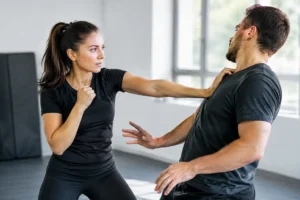
For many people, the moment before their first sparring session feels more intense than the round itself. Suddenly, your opponent is moving freely, strikes are no longer prearranged, and your heart rate rises. That’s exactly why good preparation for your first sparring session determines whether you’ll react nervously or learn with focus. Sparring isn’t a battle for dominance. It’s a controlled form of training in which technique, sense of distance, self-control, and respect develop under more realistic conditions.
What Your First Sparring Session Should Really Achieve
In your first sparring session, you don’t need to prove to anyone how tough you are. Your goal is to stay calm, maintain clear vision, and work with your partner rather than against him. Those who only want to win often strike too hard, lose their form, and miss out on valuable learning opportunities.
A good first round can already be considered a success if you regain your guard after every attack, maintain your distance, and react to your opponent’s moves. Maybe you won’t land a clear hit. Maybe you’ll get hit a few times. That’s all part of it. The key is to take away a specific lesson from it: Was your distance too short? Did your hands drop? Did you lose your balance while stepping back?
Here, too, “tradition meets modernity” means that the principles of Wing Chun—such as structure, center, and control—meet the fluid distance work of modern striking martial arts. Sparring allows these principles to be put to the test.
Preparation for the first sparring session begins during training
The best preparation doesn’t happen on the day of the sparring session, but in the weeks leading up to it. Practice your basic stance, footwork, blocking, and simple combinations often enough that you can recall them under pressure. For beginners, just a few techniques are enough to start with: a straight punch, a solid block, a step back or to the side, and the ability to regain a stable position.
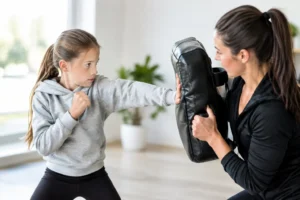
Controlling the intensity is especially important. Striking with clean technique and precision requires more skill than hitting wildly and hard. Therefore, practice pad work, partner drills, and movement sequences with clear objectives. Those who learn to maintain eye contact, keep their shoulders relaxed, and not flinch at every feint will enter the first round with a solid foundation.
Your fitness level also matters, but it doesn’t have to be perfect. You don’t need to be in competition shape to get started. However, you should be able to work through short rounds with focus. Two to three light interval sessions with shadow boxing, jumping rope, or simple technical drills will help you more than a grueling strength test the night before.
Protective equipment and clear rules build trust
Sparring without the proper equipment and agreed-upon rules is not a form of challenging training, but an unnecessary risk. The equipment required depends on the discipline, the rules, and the training goal. As a general rule, this includes appropriate gloves, a mouthguard, and, if necessary, shin guards. For children and adolescents, there are particularly clear safety guidelines, as well as closely supervised sparring partners.
Before you start, talk openly with your partner and the coaching staff: What are the goals for this session? Just boxing, or kicks as well? Are head shots allowed? How intense will the workout be? These questions aren’t a sign of insecurity, but rather of being ready to train.
You can tell when sparring is good when both participants improve after the round. If you notice that the intensity is increasing, you feel overwhelmed, or you feel an injury coming on, speak up immediately. Respect doesn’t mean putting up with everything. Respect means taking responsibility for yourself and your partner.
In the Round: Stay Calm, Breathe Deeply
Many beginners make the same mistake: In the first few seconds, they try to do everything at once. They expect their attacks, defenses, dodges, counters, and power to all work simultaneously. This creates a frantic situation. Instead, choose a simple task for your round, such as: “I’ll keep moving and maintain my guard” or “After each combination, I’ll step back to maintain distance.”
Exhale as you strike, and don’t hold your breath. Calm breathing reduces tension in your shoulders and jaw. Don’t look at your partner’s hands; instead, focus on their chest and shoulder line. That way, you’ll spot movements sooner without being fooled by every feint.
If you get hit, stay fair. Don’t strike back just to “even the score” right away. Acknowledge the hit, secure your position, and keep working. It is precisely this ability that distinguishes controlled sparring from an unstructured exchange of blows.
After sparring, it’s time to learn
The most important moments often come after the bell. Have a drink, calm down, and talk briefly with your partner or coach. Don’t just ask, “Did I do well?” Ask more specific questions: “Where did I leave myself open?”, “Was my pace right?”, and “What should I work on in the next round?”
Write down one thing that worked and one thing you want to improve. That’s all it takes. At Berlin Siu Lam Wing Chun Pai & SLWCP Fight Academy, sparring is seen as part of long-term development: train with dedication, test yourself in a controlled way, and gain confidence with every round. Put yourself out there, but stay open to learning—your effort counts when it’s grounded in discipline and respect.