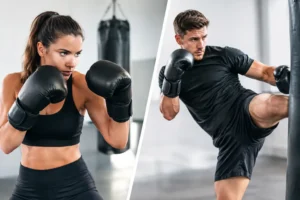
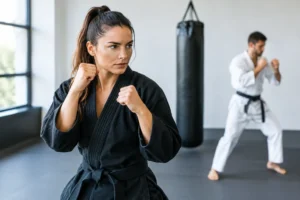
An attack rarely begins with a clean strike from a training distance. Often, people are standing too close, the path is blocked, or the situation suddenly becomes chaotic. In self-defense, footwork is therefore no minor matter for beginners: it determines whether you can create distance, change direction, or get out of a dangerous position in time.
Good footwork often looks unspectacular. No jumping, no frantic cross-steps, no movie-style fight scenes. It’s all about a stable stance, clear movements, and the ability to remain capable of acting under pressure. Tradition meets modernity: In Wing Chun, structure is key; in boxing and kickboxing, it’s agile distance work. For self-defense, we combine both with a clear goal: safety over self-promotion.
Why Footwork Comes Before Punching Power
Many beginners focus first on punches, kicks, or defensive techniques. That’s understandable, but it doesn’t go far enough. If you stand motionless in front of an opponent, you make yourself an easier target, lose distance, and can hardly react. If you control your stance, on the other hand, you can use the space, choose an open direction, and maintain your balance.
Footwork doesn’t mean pursuing a confrontation. It means creating options. A small step back can give you more reach. A step diagonally to the side can prevent you from coming to a stop right in front of someone. A controlled retreat toward the exit can be more effective than any technically flawless combination.
Self-defense follows different rules than competitive combat. In tight spaces, on uneven ground, or with bags, jackets, or other people nearby, the most elegant move isn’t always the safest. That’s why beginners start by practicing techniques that remain intuitive and reliable even under realistic conditions.
The stable base: flexible without wobbling
Your stance is the starting position for every movement. Place your feet about shoulder-width apart, with one foot slightly in front of the other. Keep your knees relaxed, and distribute your weight evenly between both legs. Your heels don’t have to be glued to the floor, but you should be able to stop at any time.
Your alignment is important: Don’t turn completely to the side, and don’t stand rigidly facing forward either. A slightly offset position gives you stability and keeps both sides of your body ready for action. Keep your hands in front of your torso in a protective position, and your shoulders relaxed. Tension should only be applied at the moment of movement, not continuously.
A common beginner’s mistake is standing too wide. It feels secure at first, but it slows you down. A stance that’s too narrow has the opposite problem: you’ll quickly lose your balance. Don’t look for a perfect template. Your height, flexibility, and training goals all play a role. The key is that you can start moving in any direction and come to a safe stop again.
The rule: The front foot leads the way
When you step forward, your front foot moves first, and then your back foot follows. When you step back, your back foot moves first, and your front foot follows. This keeps you balanced and prevents your feet from crossing.
This rule sounds simple, but it’s crucial. If you cross your legs, you’ll lose your balance for a moment and could easily stumble. This can be especially critical on curbs, wet pavement, or in tight spaces. Practice slowly and carefully until the sequence becomes second nature.
Step aside instead of stepping back straight
Walking backward creates distance, but it has its limits. Behind you, there might be a wall, a staircase, a table, or another person. If you only walk straight backward, you’re also constantly giving up space. Side steps and small angles help you avoid coming to a stop in a straight line.
Imagine you’re not moving along a track, but are looking for an open door in the room. A step diagonally outward can take you off a direct line and, at the same time, open up a path to the exit. Your steps need to stay small. Large lunges may look dynamic, but they often throw you too far off balance.
In training, this skill is first developed without pressure. You’ll learn to step forward, backward, or to the side in response to a signal and immediately regain your balance. Later, partner exercises are introduced: maintaining distance, stepping out of a line, keeping your hands up, and not looking at your own feet. Your effort counts, but speed comes only after you’ve mastered proper technique.
Understanding Social Distancing: When Movement Really Offers Protection
Footwork without a sense of distance quickly turns into aimless running around. With every exercise, ask yourself: Am I too close? Do I have a clear path? Can I stop without getting stuck? The right answer depends on the situation.
If someone is standing very close to you and pressuring you, taking a small step to the side while maintaining a confident posture is often more effective than taking a big step backward. If you have some distance and can identify a safe route, retreating may be the best solution. If you’re in a crowd, taking short, upright steps is safer than making quick turns.
Your gaze is an important part of this. Don’t stare fixedly at your hands or feet; instead, take in your upper body, arms, and surroundings all at once. In self-defense, it’s not about “reading” an opponent like you would in the ring. It’s about recognizing early on where you shouldn’t stay and where you can go safely.
Four Exercises for a Safe Start
These exercises require little space and no special equipment. Start by doing them slowly, preferably in front of a mirror or with a clear line on the floor. Focus on form rather than repetitions.
- Forward and Back: Assume your starting position. Take a small step forward, and pull the weight toward you. Take a small step back, and pull the weight toward you. Make sure your feet never cross and that your posture remains stable.
- Stepping Off the Line: Imagine a straight line. From a standing position, take a small step diagonally outward and immediately regain your balance. Repeat on both sides.
- Stop after the step: Move freely around the room for two or three steps. When you clap your hands or hear a signal, stop immediately. Check: Are your knees relaxed, your feet under control, and your hands in position?
- Finding Your Way Out: In a room, consciously look for the safest route to the door. Move toward it in small steps without taking your eyes off the door. This exercise combines footwork with orientation.
It’s better to train for five focused minutes several times a week than to train for one long session without paying attention. If you experience discomfort in your knees, ankles, or back, slow down and shorten your stride. Professional guidance is especially helpful when old injuries, a strong sense of insecurity, or very different movement patterns come into play.
What Beginners Should Avoid
Hasty jumps waste energy and leave you vulnerable on uneven ground. Equally problematic are overly large strides where your feet land far apart. This makes it difficult to slow down, turn, or take another step.
Also, avoid looking down while moving. Of course, you don’t want to trip, but you need to keep your eyes on the situation. So start by practicing on a safe surface and develop a sense of your footing. Over time, you won’t need to consciously control your feet anymore because your body will know the movement.
Another mistake is confusing movement with fleeing without a plan. If a safe retreat is possible, take it decisively. If the path is blocked, moving at an angle can help. But stay grounded in reality: Self-defense is not a competition to secure the best position. De-escalation, maintaining distance, and leaving the situation take priority.
Footwork is honed through partner training
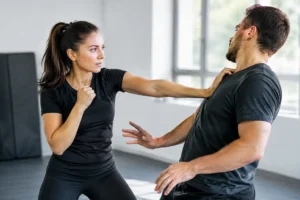
Practicing on your own builds the basics. But it’s only during controlled partner training that you’ll realize whether you can stay calm while moving. A partner changes the distance, direction, and pace. You learn not to freeze up, without reacting too hastily.
At Berlin Siu Lam Wing Chun Pai & SLWCP Fight Academy, we guide you through this process step by step. Beginners do not need a background in sports, but they do need a willingness to train regularly, pay attention to instructions, and treat others with respect. Confidence doesn’t come from a single trick, but from repeated, mindful practice within a community that challenges and supports you.
Get moving before the pressure builds up
Footwork isn’t just an extra exercise for advanced practitioners. It’s the foundation that allows you to use your hands effectively, maintain distance, and recognize a safe path. Start slowly, keep your form clean, and give yourself time. With every controlled step, not only does your technique improve, but so does your confidence in not freezing up when faced with a difficult situation.