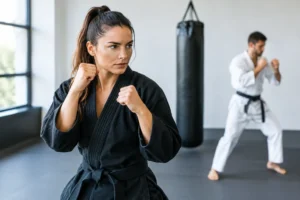
At 40, you often feel the difference between movement and training more clearly than you did at 20: A stiff back makes itself felt after sitting for a long time, your stamina doesn’t come naturally anymore, and at the same time, the desire to feel strong, confident, and flexible grows. Starting martial arts training after age 40 isn’t a case of starting too late—it’s a conscious decision. You’re not training to prove anything to anyone else. You’re training because your body deserves your attention and because self-confidence comes from experiencing your own ability to take action.
Martial Arts Training for People Over 40: Why Now, of All Times?
Many people put off taking that first step because they think they’re too inflexible, too out of shape, or too old. That’s understandable, but it’s rarely a good reason not to start. Martial arts aren’t a sport that relies solely on explosiveness. Technique, timing, spatial awareness, structure, and composure under pressure are skills that develop with patience and focused training.
Especially after 40, your perspective on performance changes. Not every workout has to be as intense as possible. What matters most is that you can train regularly, notice progress, and stay healthy. A clean strike, a stable stance, or the ability to safely extricate yourself from a difficult situation are tangible results. They don’t happen overnight, but they’ll reliably develop if you stick with it.
Martial arts also give training a purpose that goes beyond burning calories. You learn to improve your posture, recognize your limits more clearly, and not freeze up immediately when faced with stressful situations. This can be just as valuable in everyday life as it is in the training room.
Don’t train to be younger—train to be smarter
The most common mistake when starting out isn’t a lack of determination, but misplaced ambition. If you treat every workout like a competition right after years of inactivity, you risk overexertion and will quickly lose your enjoyment of it. A good start begins with an honest self-assessment: How resilient are your joints, back, and cardiovascular system? Are there any past injuries, surgeries, or health issues the training team should be aware of?
That doesn’t mean you have to play it safe and stay on the sidelines. It means that the workload is managed sensibly. Intensity can increase. Flexibility, strength, and endurance develop alongside your technique. Some days are challenging, while others are dedicated to precisely repeating movements, moving freely, and sharpening your body awareness.
Anyone who hasn’t exercised in a long time or has pre-existing health conditions should consult a doctor before starting a workout routine. This isn’t a sign of insecurity, but rather a responsible way to prepare. During the workout itself, open communication and professional guidance help you adapt the exercises without losing sight of the challenge.
What Really Matters at the Beginning
You don’t need to be able to do the splits or already know how to punch. What’s more important is a willingness to learn, consistency, and the determination to embrace unfamiliar movements. The first few weeks often feel technically challenging. Your hands and feet need to work in coordination, you mustn’t lose your breath under pressure, and suddenly it becomes clear just how much concentration a controlled partner drill requires.
That’s exactly where the value lies. You’re not just training your muscles—you’re training your focus. With every repetition, your form becomes more stable, your movements more efficient, and your sense of distance more precise. That’s progress, even if it doesn’t always look dramatic or spectacular.
Which martial art fits your goals?
The right path depends on what you’re looking for. If you value traditional forms, body structure, and close-range combat techniques, Siu Lam Wing Chun offers a challenging approach. The training develops coordination, reaction time, and a sense of how to use force efficiently. Chi Kung can be a useful complement if you want to consciously train your breathing, posture, and inner calm.
If you’re drawn to direct punch combinations, endurance, and footwork, boxing or kickboxing offer clear training goals. You’ll learn defense, timing, distance, and how to work with partners in a controlled manner. Grappling and MMA expand the range to include clinching, takedowns, ground fighting, and transitions between different ranges. Realistic self-defense, however, requires more than just individual techniques: it also involves awareness, de-escalation, clear boundaries, and simple movements that can be executed under stress.
You don’t have to make a final decision right away. A versatile school can be a good choice, especially for beginners over 40, because it combines tradition with modern training methods. The key is that the training group aligns with your goals and that you aren’t treated as an exception there, but rather as a beginner who should be taken seriously.
Safety comes from control, not from leniency
Martial arts are contact sports. That makes them authentic, dynamic, and sometimes exhausting. At the same time, unnecessary roughness is not a sign of quality. Effective partner training thrives on control. You learn to feint strikes or deliver them with measured force, to respect your partner’s limits, and to clearly communicate when the pace or intensity needs to be adjusted.
Professional guidance recognizes the difference between appropriate exertion and risky behavior. Technique is built up gradually at first, before speed and intensity increase. Protective gear may be required, depending on the type of training. Warm-ups, mobility exercises, and a proper cool-down are not mere formalities, but part of a culture that enables long-term development.
An environment where questions are encouraged is especially valuable. Why is the foot positioned that way? Why is this hand protecting the chin? How do I fall safely? Those who understand the reasons learn faster and are better able to adapt movements to their own bodies.
Here’s what a good introduction looks like
Two workouts a week are a great start for many adults. They provide enough repetition without immediately overwhelming your daily routine. In addition, walks, light strength training, or short mobility exercises at home can help. If you can only work out once a week, you should still get started. Consistency beats the perfect plan that gets abandoned after ten days.
Don’t set unrealistic goals for the first three months, like competing or mastering a hundred techniques. Make it a point to show up regularly, learn names and basic stances, and take away one thing after each session that worked better than before. Maybe it’s a more stable guard. Maybe a more relaxed shoulder. Maybe the realization that you’re in better shape than you thought.
Recovery is also part of your workout routine. Sleep, staying properly hydrated, and managing your workload wisely all affect how well you can train. Muscle soreness is normal, especially at the beginning. Sharp pain, persistent joint discomfort, or a distinct feeling of being overwhelmed, on the other hand, are signs you should take seriously.
Community Makes the Difference
You can be consistent on your own at the gym. But in a training group, something extra emerges: a sense of commitment. Your training partners challenge you, help you learn, and show you that everyone started with the basics at some point. Respect isn’t just an empty phrase here. It shows in the tone of voice, in controlled interaction, and in the way experience is passed on.
At Berlin Siu Lam Wing Chun Pai & SLWCP Fight Academy, this spirit of community meets a training program that brings together various martial arts styles. The focus is on the individual—with their current skill level, their goals, and their willingness to work with dedication. Tradition meets modernity not as a marketing slogan, but where precise fundamentals meet contemporary training methods and practical self-defense.
For people over 40, this atmosphere can be especially important. You don’t need someone trying to show off; you need training partners who are reliable. You don’t need false promises of quick results; you need coaches who challenge you, correct your form, and take your progress seriously.
The first step is not a test
A trial class isn’t a test you have to pass. It’s an opportunity to find out what the class is like, how the group interacts, and whether the instruction style suits you. Come in comfortable workout clothes, be honest if you haven’t worked out in a while, and see how your questions are answered. A good workout challenges you without making you feel embarrassed.
Don’t wait until you feel fit enough. Fitness is often the result of getting started, not a prerequisite. Get in the game, learn to fight with control, and give yourself the time it takes to truly develop. Your effort counts—today, during your next session, and far beyond training.