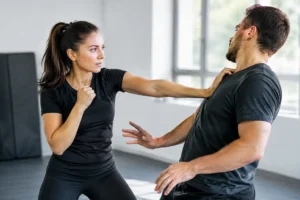
When your heart rate rises, your legs feel heavy, and you still can’t get a technique right on your third try, that’s when training goes beyond mere fitness. Mental strength in martial arts is forged precisely in these moments: not through loud slogans, but through the decision to stay calm, learn attentively, and try again.
Many people come to training because they want to move, defend themselves, or challenge themselves physically. Those are good reasons. Over time, however, they realize that the real benefit often lies in how they deal with pressure, mistakes, and uncertainty. A round of sparring, a challenging form, or a controlled grappling session holds up a mirror to us. Those who are willing to look not only develop technique but also character.
What Mental Strength Really Means in Martial Arts
Mental strength is often confused with toughness. It’s not about being fearless, ignoring pain, or always having to win. A strong martial artist knows his limits, protects himself and his training partners, and remains in control even under pressure.
In Wing Chun, this can mean maintaining your own structure despite pressure, rather than lashing out wildly. In boxing or kickboxing, it means not losing your composure after landing a clean hit. In grappling, it shows itself in the ability to work technically from an unfavorable position instead of tensing up. The methods differ, but the principle remains the same: You control your reaction instead of letting it control you.
This skill is valuable in everyday life. Those who have learned through training to breathe while under stress, assess situations, and stay focused often respond more clearly in conflicts, during exams, or at work. Martial arts don’t automatically make you fearless. But they do give you the tools to remain capable of acting even when under stress.
Martial arts and mental strength develop through repetition
A single hard workout doesn’t change anyone permanently. Growth comes from regular, honest repetition. You show up on a day when your motivation is low. You practice a movement that feels unnatural at first. You accept feedback even though it challenges your self-image. That’s exactly how discipline is built.
Discipline is neither a punishment nor rigid drill. It is the ability to stay true to a meaningful decision, even when it would be more comfortable to take a break. A consistent training routine provides structure. Those who train purposefully two or three times a week see progress not as a coincidence, but as the result of their own effort.
Beginners, in particular, benefit from taking small goals seriously. The first benchmark isn’t the perfect high kick or a quick victory in sparring. Maybe at first you’ll manage to keep your guard up for an entire round. Maybe you’ll consciously exhale before a partner drill instead of tensing up. Or you’ll ask for help instead of trying to cover up a mistake. These aren’t trivial matters. They’re solid progress.
Mistakes are information, not a judgment
Martial arts training is honest. A gap in your defense becomes apparent. Standing too close becomes noticeable. If you’re not focused, you’ll quickly realize that your timing and balance are off. This can be frustrating, especially for people who set high standards for themselves.
The key question isn’t, “Did I do well today?” but rather, “What did I learn today?” A mistake shows you what you can work on. It says nothing about whether you’re cut out for training. Experienced martial artists have made no fewer mistakes than beginners. They’ve learned to analyze them more precisely and work on them patiently.
This attitude also changes the dynamics within the group. Those who accept mistakes as part of the learning process can train openly. This fosters a sense of security, respect, and better growth for everyone. Training hard and training mindfully go hand in hand.
Staying Calm Under Pressure: What Sparring and Partner Training Teach Us
For many, controlled sparring is the moment when mental challenges become particularly apparent. Some retreat too early, others become frantic, or unconsciously hold their breath. Still others are so determined to prove how strong they are that they lose their technique and sense of the situation.
Good sparring isn’t a test of ego. It’s a learning environment with rules, protective gear, clear agreements, and a sense of responsibility for one another. The intensity must be appropriate for the level of experience. A teenager needs different conditions than an adult with competitive experience. Even after a stressful day at work, technically sound, light sparring is often more beneficial than an unnecessarily hard exchange of blows.
Anyone who trains regularly under controlled pressure learns three important things: First, to recognize tension without immediately panicking. Second, to make decisions even when not everything is predictable. Third, to get back on track after a mistake. That is mental strength—and it can’t be faked.
Self-defense also benefits from this. Self-protection doesn’t start with spectacular techniques, but with awareness, clear communication, and the courage to set boundaries. Martial arts can help you become more aware of your own body language and act in ways that de-escalate situations. If it’s possible to create distance and walk away, that’s not a retreat born of weakness—it’s a wise decision.
Concentration is a skill that can be developed
Many people experience their daily lives as a succession of notifications, appointments, and distractions. In training, however, what matters is the present moment: stance, breathing, distance, focus, and partner. Even a simple exercise can challenge your concentration if it’s performed correctly.
Qigong, forms, and precise technical drills offer a different approach than sparring. They require patience and body awareness. Those who focus on aligning their posture, maintaining a steady breathing rhythm, or repeating a sequence of movements cultivate the ability to stay focused on a task. At first glance, this may seem still, but it is by no means passive.
This experience is especially valuable for children and teenagers. They learn to follow rules, control their impulses, and treat others with respect. At the same time, they get to burn off energy, build confidence, and experience success. A pedagogically guided training program sets clear boundaries without belittling children. Performance and enjoyment are not mutually exclusive.
Three Routines for Greater Inner Stability
Mental development doesn’t require a complicated plan. It requires repetition and honesty. Before practice, it helps to set a specific goal—such as focusing on your own defense or consciously breathing in a relaxed manner. After practice, two minutes are enough for a brief review: What worked, and what should I work on next time?
Even outside the gym, a simple breathing routine can be helpful. Before a difficult conversation, take a slow breath in and a longer breath out. Straighten your posture, feel the ground beneath your feet, and only then speak. This isn’t a substitute for conflict resolution, but it creates a moment between stimulus and response.
And: Don’t constantly compare your progress with that of others. A training community thrives when more advanced members provide guidance and beginners feel free to ask questions. Your benchmark is the person you were a few weeks ago. Your effort is what counts, even if it’s less than planned on some days.
Tradition meets modernity—people come first
Traditional martial arts instill values such as respect, perseverance, and a sense of responsibility. Modern combat sports complement these with proven training methods, realistic distance work, and athletic endurance. This combination is not a contradiction. It becomes powerful when it does more than simply accumulate techniques—it provides meaningful guidance to people.
At Berlin Siu Lam Wing Chun Pai and the SLWCP Fight Academy, traditional systems such as Siu Lam Wing Chun and Shaolin Kung Fu are combined with boxing, kickboxing, grappling, MMA, Chi Kung, and practical self-defense. The key isn’t to list as many styles as possible. What matters is which exercises will help you reach your current goal and how professionally they are taught.
Some want to develop competitive ambitions, while others are looking for a focused way to unwind or want to move with greater confidence. Mental strength doesn’t always look the same for these people. For one person, it’s the courage to try out a class for the first time. For another, it’s the patience to keep refining the basics even after years of practice. Both steps deserve respect.
Don’t come to training expecting to become someone else right away. Come to reliably face what challenges you. With every clean repetition, every fair round, and every conscious response to setbacks, you’ll develop a strength that will sustain you even when no one is watching.