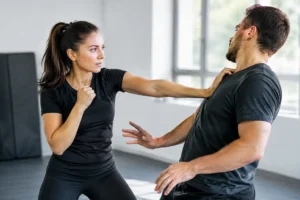
The decision between martial arts and the gym rarely starts with questions about equipment or workout plans. It’s usually about something more personal: Do you just want to get fitter, or do you want to learn to stay calm under pressure, use your body in a purposeful way, and grow as part of a community? Both can make you strong. But the nature of that strength is different.
A gym offers you a space for personalized training, muscle building, and endurance. Martial arts, in addition, require focus, technique, proper posture, and treating others with respect. If you want to make the right choice, you shouldn’t just look at calorie burn or the monthly fee—you should consider the goal behind your training.
Martial Arts or the Gym: Two Ways to Improve Your Performance
At the gym, you largely get to decide your own pace, choice of exercises, and workout duration. This is a big advantage for people with clear plans, workout experience, or a busy schedule. You can focus on your back, legs, or endurance, take a class, or keep your session short if you’re short on time.
At the same time, this freedom requires personal responsibility. Without proper technique, a well-thought-out plan, and regular adjustments, many exercisers end up doing the same routine for months on end. The workouts feel strenuous, but progress falls short of what’s possible. Beginners, in particular, often don’t know whether they’re pushing themselves too little, overdoing it, or simply mimicking the exercises.
Martial arts training is organized differently. You don’t just come to count repetitions. You work on distance, timing, coordination, power transfer, flexibility, and reaction time. A training partner immediately shows you whether your form is correct. A coach corrects details that you’d hardly notice on your own in the mirror. Progress isn’t just visible—it’s tangible: You move with greater precision, react more consciously, and remain capable of acting even when under strain.
That doesn’t mean martial arts are always the best option. If your goal is simply to build strength as efficiently as possible, do rehabilitation training, or work out without having to stick to a set class schedule, the gym might be the perfect place for you. The key is whether you’re looking for a place to work out or want to develop a skill.
What a gym does especially well
A well-equipped gym offers clear advantages for strength training. Machines allow for controlled resistance, free weights build functional strength, and cardio equipment helps systematically improve cardiovascular performance. Those training for a competition, a physical test, or a specific health goal can tailor their program very precisely.
Flexibility is also a major selling point for many Berliners. Whether early in the morning, during lunch break, or late at night—it’s often easier to fit in a workout between work, family, and other commitments. People who already know how to exercise effectively are particularly good at taking advantage of this flexibility.
But fitness alone doesn’t address every reason for working out. Strong shoulders are valuable, but they don’t replace the ability to create distance in a confusing situation. Good endurance helps you in everyday life, but it doesn’t automatically develop decision-making skills, body language, or the ability to handle closeness and pressure in a controlled way.
Martial arts train the body, mind, and behavior
Martial arts are not a substitute for traditional strength training, but rather a different kind of comprehensive program. In Wing Chun, Kung Fu, boxing, kickboxing, grappling, or MMA, many physical skills come together at the same time. You learn not only to build strength, but also to use it at the right moment. You develop balance, flexibility, and endurance while mastering technical skills.
The key difference lies in who you’re training with. A punching bag doesn’t fight back, doesn’t change its angle, and doesn’t put you under pressure. A training partner does exactly that—safely, in a controlled manner, and at a level appropriate for you. This creates a training environment that demands concentration. You have to perceive, decide, and act, rather than simply going through the motions.
Self-defense requires more than just physical fitness
Many people take up martial arts because they want to feel safer. That’s an understandable goal, but it deserves an honest answer: Self-defense isn’t just a collection of spectacular techniques. It starts with awareness, clear boundaries, de-escalation, and the ability to recognize danger early on.
When physical action becomes necessary, what counts are simple movements that can be performed under stress. That is why practical training combines technical fundamentals with realistic situations, maintaining a safe distance, and controlled contact. It is not about seeking out conflicts. It is about being able to protect oneself, taking responsibility, and expanding one’s own scope of action.
Discipline comes from consistent training
At the gym, you have to reignite your motivation every time you go. In martial arts class, the group helps with that. You’re not just there for yourself. Your training partners count on you to stay focused and participate respectfully. This sense of commitment is especially helpful on days when that inner voice of doubt sounds very convincing.
Discipline doesn’t mean pushing yourself to the limit at any cost. A good training program takes into account your daily condition, injuries, and individual circumstances. Your effort matters, but safety matters just as much. If you want to train for the long term, you have to learn to be both ambitious and smart.
Which path is right for whom?
If your main goal is to build muscle and you prefer to work out on your own following a clear plan, a gym is often the obvious choice. Even if you need to have complete flexibility with your schedule, it may fit better into your daily routine. In addition, a strength training program can be very beneficial for martial artists, for example, to improve explosiveness, stability, or endurance.
If you’re looking for technical skills, self-confidence, and social connections in addition to fitness, martial arts are a great choice. This applies to beginners as well as to people who want to reintroduce exercise into their daily lives after years of inactivity. You don’t have to be flexible, in great shape, or brave to start. These qualities develop through training.
Martial arts can be particularly valuable for teenagers because they channel energy into clear rules and goals. They learn that respect isn’t just a requirement, but the foundation for effective training. Children benefit from age-appropriate exercises that promote coordination, concentration, and body awareness, without confusing the pressure to perform with being overwhelmed. Parents should look for pedagogically trained instruction, strict safety standards, and an atmosphere where development takes precedence over self-promotion.
For ambitious adults, the right balance is key. Traditional systems instill structure, discipline, and technical depth. Modern striking, ring, and competition methods test whether movements work even under dynamic conditions. Tradition meets modernity—not as a marketing slogan, but as a training principle: Preserve what has substance, and supplement what makes you more capable of action.
You don’t make the best decisions in front of a screen
Descriptions can give you some guidance, but they’re no substitute for training. During a trial session, pay attention to how beginners are treated. Are the movements explained clearly? Are there clear rules regarding contact and safety? Do the coaches provide individual feedback? And most importantly: Do you feel challenged without having to prove yourself?
A good workout should be challenging. It should push you out of your comfort zone and show you what you can work on. But it shouldn’t make you feel inadequate. The right school creates an environment where beginners are taken seriously and advanced students don’t get stuck in a rut.
That’s why the Berlin Siu Lam Wing Chun Pai & SLWCP Fight Academy puts the individual at the center: their current level, their goals, and their willingness to keep learning. Whether you eventually strike harder, react more calmly, or finally find joy in regular exercise isn’t determined by a single grueling training session. It’s the habit of coming back that makes the difference.
Give yourself the chance to honestly explore both worlds. If free training on equipment keeps you motivated in the long run, stick with it. If you’re looking for a workout that challenges you physically and helps you grow as a person, step onto the mat. Your next step forward begins when you stop just watching and start getting involved.