My mind keeps working even though the workday is long over. Appointments, conflicts, news, and the pressure to perform well in every situation keep my body on high alert. Do martial arts help relieve stress? For many people, yes—not as a quick escape from problems, but as a regular practice that transforms tension into movement, concentration, and a calm state of mind that enables action.
Martial arts require focus. Anyone who is practicing a punch correctly, gauging distance, or guiding a partner’s movements cannot simultaneously go over every pending task in their mind. This is precisely where its particular strength lies: Training creates a clear framework in which the body and mind must work together again.
Do Martial Arts Help Relieve Stress? The Honest Answer
Martial arts can significantly reduce stress, but they are not a cure-all. The type of training, intensity, instruction, and your individual circumstances are all crucial factors. Anyone who is chronically overwhelmed, has trouble sleeping, or suffers from severe anxiety, depression, or trauma may need additional medical or therapeutic support. Training alone is no substitute for this kind of help.
However, martial arts can be very beneficial as a healthy, active outlet. Physical exertion helps release pent-up energy. At the same time, you’re practicing something that has become rare in our hectic daily lives: consciously focusing your attention on a single thing for a limited time. The next move, your posture, your breath, your partner—nothing else matters in that moment.
Unlike mindless exertion, the goal isn’t just to get tired. Traditional systems like Wing Chun or Shaolin Kung Fu focus on structure, posture, and controlled tension. Boxing, kickboxing, grappling, and MMA complement this with direct, dynamic resistance. This combination challenges you without creating chaos—provided the training is professionally structured.
Why Exercise Can Calm the Mind and Body
Stress isn’t just a thought. It manifests itself in shallow breathing, raised shoulders, a tight chest, irritable reactions, and the feeling of having to react at any moment. Martial arts make these states tangible. And they offer specific counter-movements.
Movement gives tension a direction
After a strenuous day, many people carry tension in their bodies without realizing it. During training, this tension becomes apparent: in a grip that’s too tight, a hasty stroke, a stiff neck, or a lack of endurance. This tension can be released through repeated, technically guided movements.
That doesn’t mean every training day has to be as hard as possible. An intense sparring session can be liberating. On another day, slow technical training, form practice, or qigong can be more effective because they focus on breathing and body awareness. Good martial arts encompass both sides: determined effort and conscious control.
Concentration stops the mind from going in circles
Martial arts are challenging enough to quiet the inner noise. During a partner drill, you have to be aware of your surroundings, maintain your distance, react, and stay in control all at the same time. The brain is given a task with immediate feedback. Worrying takes a back seat for a while.
This effect is particularly evident when beginners aren’t overwhelmed with too many techniques. A clear exercise, repeated several times and corrected properly, is often more valuable than an overloaded training plan. Progress comes from attention, not from mere busyness.
Controlled pressure builds resilience
Stress cannot be completely avoided. The key question is: How do you remain capable of acting when pressure mounts? Sparring, drills, and grappling situations can help you train for exactly that—in a safe environment with rules, respect, and clear boundaries.
This is not about glorifying aggression. On the contrary: Those who learn to breathe calmly under pressure, maintain their distance, and act with technical precision develop greater self-control. Physical confrontations in training are not sought out as a way to vent frustration. They are structured in such a way that they foster experience, discipline, and trust.
Not every martial arts workout is relaxing in the same way
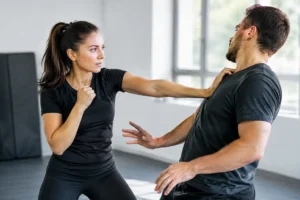
The right type of workout depends on your personality, daily routine, and goals. People who sit all day and feel pent up often benefit from dynamic sessions that include punches, kicks, and endurance training. Those who are already under constant pressure at work may find that precise technique, partner drills, and breathing exercises provide a better balance.
Sparring, too, is all about getting started the right way. For some, it becomes motivating after just a few weeks because it instills courage and clarity. Others need a solid technical foundation first. Both approaches are valid. Too much pressure at the wrong time can increase stress, while measured challenges build self-confidence.
That’s why the training culture matters. A good team knows the difference between challenging and overwhelming. It pays attention to protective gear, partner selection, clear instruction, and ensuring that a beginner doesn’t have to prove how tough he or she is. Respect is no trivial matter—it’s what makes intense training sustainable in the first place.
This is how martial arts become a reliable way to relieve stress
The greatest impact rarely comes from a single spectacular workout. It happens when exercise becomes a regular part of your routine that gives structure to your daily life. For many beginners, just two sessions a week are enough to notice changes: better sleep, more energy, a clearer mind, or a different way of dealing with stress.
Don’t set the wrong goal for yourself. You don’t have to be able to fight perfectly after four weeks, nor do you have to leave every workout completely exhausted. It makes more sense to ask yourself a simple question after each session: Am I more present now than when I arrived? Over time, this will give you a better sense of what level of intensity is right for you.
A few guidelines are especially helpful:
- Exercise regularly, but be just as mindful about scheduling time for recovery.
- Start with the technical aspects and increase the intensity only as your confidence grows.
- Let the coaching staff know if you’re currently under a lot of stress, injured, or exhausted.
- Don’t constantly compare your progress with others’—compare it with where you started.
Working professionals, in particular, often underestimate the value of a dedicated space. At home, exercise quickly becomes nothing more than a good intention somewhere between the couch and the screen. In training, there’s a group, a structured routine, and a shared goal. At the Berlin Siu Lam Wing Chun Pai & SLWCP Fight Academy, tradition and modernity come together: people train with focus, support one another, and take responsibility for their own progress.
What Children and Teens Take Away From It
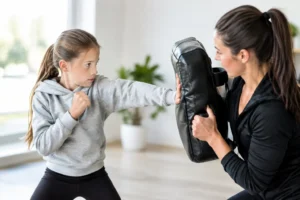
Children and teenagers also experience stress: pressure to perform in school, conflicts, constant digital stimuli, and feelings of insecurity in group settings. Martial arts can help them get to know their bodies better and avoid acting out their emotions immediately. Those who learn to listen during an exercise, maintain their distance, and continue fairly after taking a hit are training far more than just coordination.
Educational quality is particularly important here. Children’s training should not simply be a scaled-down version of adult sparring. It requires clear rules, age-appropriate activities, a sense of accomplishment, and an atmosphere where respect is visibly practiced. Then physical activity can boost self-confidence without causing performance anxiety.
For parents, one distinction is crucial: assertiveness does not mean that a child should resolve conflicts through violence. Effective self-defense begins earlier—with good posture, a clear voice, attentiveness, and the ability to seek help. Martial arts teach these skills in a practical and engaging way.
When It’s Wise to Be Cautious
If you’re extremely exhausted, you shouldn’t try to mask every problem with more intense training. If your heart rate is already racing during everyday activities, if you’ve been unable to sleep for an extended period, or if panic and depression are dominating your daily life, you need professional help. Talk openly with medical or mental health professionals and adjust your training accordingly.
Even after injuries, extended breaks, or during periods of high work stress, less is sometimes more. Technique, light exercise, and breathing exercises can be more beneficial than intense sparring. Discipline doesn’t mean ignoring warning signs. Discipline means staying trainable in the long run.
Stress won’t go away just because you hit a punching bag or run a lap. But you can learn not to be completely at its mercy every time. Come to the workout, take the time to focus on the basics, and see how things change when your body starts working with you again instead of just being under pressure.