A grab on the wrist, a shove on a crowded train, a scuffle outside a club: In moments like these, the question “grappling or self-defense” suddenly feels very real. Both disciplines can give you a sense of security and self-confidence. But they pursue different goals. Those who understand this train with greater focus—and don’t expect either the sport or self-defense to do something that neither can achieve on its own.
Grappling or Self-Defense: It’s Not Really an Either/Or Situation
Grappling involves fighting in the clinch and on the ground: controlling, throwing, holding, escaping, and positioning. It incorporates elements from wrestling, Brazilian jiu-jitsu, judo, and MMA, among others. In training, you’ll learn to withstand pressure, disrupt your opponent’s balance, and remain calm even when you lose distance and your sense of the situation.
Self-defense starts earlier. It’s not just about physical confrontation, but also about awareness, clear communication, distance, escape routes, and de-escalation. Physical techniques are important, but they’re only part of the picture. The goal isn’t to win a fight. The goal is to get out of a dangerous situation safely.
That’s why the helpful question is usually not: “Which is better?” but rather: “What skill am I currently lacking—and under what conditions do I want to develop it?” For those who want to challenge themselves physically, become more confident in physical contact, and develop realistic control in close-quarters combat, grappling offers a powerful path. Those preparing for typical everyday situations also need to develop a mindset for self-defense, understand striking range, engage in scenario-based training, and learn to make decisions under stress.
What Grappling Really Teaches You
Grappling is honest. When a training partner controls your upper body or you’re pinned beneath them, there’s no room for wishful thinking. You immediately realize whether your posture is stable, whether you’re using tension effectively, and whether you can still breathe, think, and act under pressure.
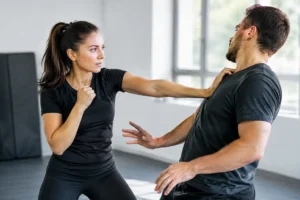
This experience is particularly valuable because many confrontations don’t start at a safe striking distance. People grab at clothing, cling on, shove, or hold on tight. Those who have never trained with resistance are often startled by the proximity and strength of their opponent. Regular grappling takes the shock out of that closeness. You’ll learn to recognize positions, establish frames, escape from unfavorable situations, and get back on your feet.
Good grappling also develops timing, body awareness, and resilience. It requires technique rather than mere brute strength. A smaller person can be much more effective by using angles, balance, and control than by relying on brute force. This makes the sport just as interesting for beginners as it is for experienced martial artists.
Competitive grappling, however, has rules. There is usually a defined area, a training partner who doesn’t bite, doesn’t use objects, and doesn’t bring friends along. These conditions are what make intensive learning possible in the first place. However, they cannot be equated with a chaotic conflict situation on the street.
Where Self-Defense Takes a Different Approach
Practical self-defense asks: How do I recognize suspicious behavior early on? Where should I position myself? How do I set a clear boundary? When should I leave the situation? And what do I do if I can’t get out of the way?
These aren’t just theoretical details. Those who resolutely walk away, organize help, or keep their distance are often making the strongest decision. Self-defense doesn’t mean accepting every provocation. On the contrary: it requires discipline, because the ego must learn not to react to every challenge.
When physical resistance becomes necessary, simple movements that can be performed under stress are key. A stable stance, protecting your head, moving, speaking loudly, breaking free from holds, and creating distance are essential. Depending on the situation, punches, kicks, or clinching may play a role. Context is always crucial: the number of people involved, the surroundings, potential weapons, the ground conditions, and escape routes can instantly change the situation.
From both a legal and a human perspective, violence is not a training exercise. Self-defense must remain proportionate. A serious training program, therefore, does not foster the illusion of control over every situation, but rather provides guidance, a sense of responsibility, and practical routines for taking action.
Why Ground Fighting Is Important—and Why It Should Rarely Be the Goal
A common misconception is: “You should never go down on the street.” That’s too sweeping a statement. No one plans to fight on asphalt, among broken glass, or near other people. Still, a fall can happen. Maybe you’ll get shoved, slip, or end up on the ground while being held in a hold.
This is exactly where grappling comes in. You learn how to handle falls better, protect yourself from unfavorable positions, create space, and get back to your feet. This skill is more relevant to self-defense than the idea of engaging in a long, technical fight on the ground.
The priority remains clear: Don’t let yourself be pinned down, don’t get tied up unnecessarily—get up and get away. Grappling expands your arsenal for this purpose. However, it does not replace distance management or de-escalation. If you’re only strong on the ground, you have a weakness. If you completely ignore ground fighting, you do as well.
Which entry-level option is right for whom?
If you’re looking for an intense athletic workout, enjoy working toward clear goals, and aren’t afraid of physical contact, grappling is an excellent place to start. You’ll quickly realize how closely fitness, flexibility, and technique are linked. It’s also an essential foundation for anyone interested in MMA.
If your main goal is safety in everyday life, start with self-defense in an environment that teaches scenarios in a responsible way. You should learn to set boundaries verbally, understand stress reactions, and repeatedly practice simple physical techniques. Supplementary grappling training is particularly useful for gaining practical experience with escapes and close-range combat, rather than just theoretical knowledge.
For teenagers, the combination of these two approaches is particularly effective: They learn not to let themselves be provoked, not to escalate conflicts recklessly, and yet to carry themselves with physical confidence. For children, the focus is on age-appropriate training. Movement, coordination, respect, rules, and safe interaction lay the foundation on which self-assertiveness can grow.
Resistance training makes all the difference
A technique doesn’t become effective just because it was demonstrated once at a slow pace. It must be practiced at various distances, with increasing resistance, and under guidance. The goal is not to overwhelm beginners. It is to develop a sense of reality, step by step.
In controlled partner training, you’ll learn to adjust the intensity, take responsibility for your partner, and remain calm yourself. This protects you from two extremes: the fear that arises from a lack of experience, and overconfidence that can result from exercises that are too easy.
At Berlin Siu Lam Wing Chun Pai & SLWCP Fight Academy, traditional martial arts are therefore combined with boxing, kickboxing, grappling, MMA, and practical self-defense. Tradition meets modernity—not just as a catchphrase, but in training: structure, respect, and discipline are combined with realistic distances, resistance training, and personalized instruction.
How to Find a Training Plan That Works for You
You don’t have to commit to one discipline forever. A good training path is allowed to evolve. Maybe you’ll start with self-defense because you want to feel safer, and later discover a passion for competitive grappling. Maybe you’ll come to training through competition and realize that self-defense skills give you added security in everyday life.
When choosing a class, make sure that safety is taken seriously, that instructors provide clear feedback, and that participants of different skill levels can train together respectfully. Good groups are challenging but not inconsiderate. Your commitment matters—and it grows best in an environment where you can train regularly, ask questions, and make mistakes.
Get involved without having to prove yourself. Those who learn to maintain their distance, communicate clearly, let go of a grip, and stay calm under pressure gain more than just techniques from training: they develop an attitude that makes a tangible difference in everyday life.