That first hard hit in sparring, the moment before your first competition, or a threatening situation on the street—in those moments, it’s not how many techniques you know that matters, but what you can actually apply under pressure. That’s why the question of Kung Fu versus MMA is more than just a matter of style. It helps determine how you train, how you grow, and what role martial arts should play in your life.
The honest answer is: There’s no clear-cut winner. Kung Fu and MMA have different focuses, but they can complement each other perfectly. What matters most are your goals, your willingness to train regularly, and the quality of the instruction. Tradition meets modernity when technique, posture, and realistic application are developed together rather than separately.
Kung Fu or MMA: Two Paths, One Serious Training Regimen
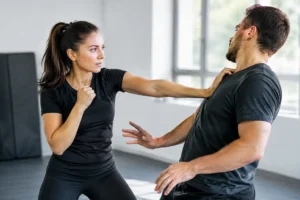
Kung Fu is not a single, unified style. The term encompasses numerous Chinese martial arts systems, each with its own principles, forms, and training methods. In Siu Lam Wing Chun, for example, the focus is on structure, sense of distance, precise hand techniques, reaction, and close-range combat. Shaolin Kung Fu features dynamic forms, punches, grappling techniques, and kicks. Traditionally, it does not include athletic training or movements that are too demanding in terms of coordination.
MMA stands for Mixed Martial Arts. It combines striking, clinching, throws, ground fighting, and submission holds. Training incorporates elements from boxing, kickboxing, wrestling, grappling, and other martial arts. MMA is strongly characterized by competitive sparring: What techniques can be effectively applied against an active, resilient training partner?
The difference does not lie in one approach being “real” and the other merely traditional. Good martial arts require verifiable application. Good modern martial arts practice benefits equally from proper body mechanics, discipline, and a deep understanding of movement. Those who merely collect techniques without practicing them remain uncertain. Those who only fight without developing the fundamentals will also reach their limits in the long run.
What Kung Fu Can Offer You
Kung Fu is particularly well-suited for people who view martial arts as a lifelong journey. You don’t just practice punches and kicks, but also posture, balance, timing, breathing, concentration, and control. Wing Chun, in particular, teaches you to sense pressure rather than reflexively stepping back. This can be valuable for self-defense and for maintaining your composure in everyday life.
Another point is technical depth. Forms, partner drills, and traditional training methods are not ends in themselves, provided they are taught in a way that is easy to understand. They develop coordination, quality of movement, and patience. Progress isn’t always obvious or immediate. A better stance, a clean step, or a calmer reaction under pressure can all be significant improvements.
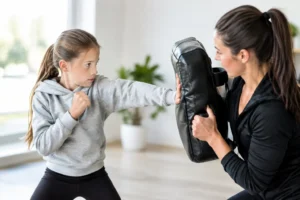
Kung Fu also provides a strong framework for children and teenagers. Respect, concentration, and reliability are all part of the training. Of course, exercise should be fun. But children also learn to follow rules, be mindful of their training partners, and consciously manage their effort. This builds self-confidence without arrogance.
The Limitation: Those who train exclusively in forms and never work with resistance will have difficulty realistically assessing distance, timing, and stress. That is why responsible partner training is essential—tailored to age, experience, and physical abilities.
What MMA Can Offer You
MMA challenges you right away. You learn early on that a fight involves different ranges: strikes from a moving position, kicks, the clinch at close range, takedowns, and ground fighting. This versatility makes MMA particularly appealing to many adults who want to develop their fighting skills in a practical way.
Sparring and controlled rolling are key tools in this process. You’ll experience resistance, learn to make decisions, and discover which techniques actually work against a moving opponent. It’s exhausting, sometimes frustrating—and that’s exactly why it’s so instructive. Mistakes become apparent—but within a safe environment, with rules, protective gear, and responsible supervision.
MMA is physically demanding as well. Endurance, strength, mobility, and resilience all improve with training. Those who train regularly often quickly notice how their fitness and self-confidence change. Still, MMA isn’t a program for people who constantly need to prove who’s the toughest. Good training partners help each other improve. Control isn’t a sign of weakness, but of skill.
The Challenge: MMA can seem overwhelming at first, both technically and physically. If you push yourself too hard too soon, you risk overexertion or losing your enjoyment of the sport. A good training program builds a solid foundation, explains techniques clearly, and gradually increases the intensity of contact.
Self-Defense: Not Just a Matter of Style
When it comes to self-defense, neither a kung fu belt nor an MMA record is a guarantee. Self-protection starts earlier: recognizing danger, maintaining distance, communicating clearly, using escape routes, and avoiding conflict whenever possible. Physical techniques are important, but they are the last resort, not the first.
If a physical confrontation is unavoidable, skills that work under stress are helpful. These include stability, basic strikes, escaping from holds, defensive maneuvers, spatial awareness at close range, and a basic understanding of ground fighting. This is precisely where practical Kung Fu training complements boxing, kickboxing, grappling, and MMA.
Self-defense must also remain realistic. Pavement, multiple attackers, confined spaces, or moments of surprise don’t follow competition rules. That’s why you’re not training for a heroic battle, but rather to remain capable of acting and to get out of a situation safely.
For competition, fitness, or personal development?
If you want to fight and test yourself in a competitive setting, MMA provides a clear framework. You’ll gain experience with rounds, physical exertion, tactical decisions, and different phases of a fight. Boxing, kickboxing, and grappling are also valuable building blocks if you want to gain specific competition experience.
If you’re looking for a traditional martial art that offers personal growth, precise technique, and cultural depth, Kung Fu might be the right choice for you. That doesn’t mean you can skip the hard work. On the contrary: Mastering the fundamentals requires patience and consistency.
Both are great for fitness. Kung Fu improves flexibility, coordination, core stability, and concentration. MMA challenges your cardiovascular system, strength endurance, and reaction time. Which one suits you better often depends on what keeps you motivated in the long run. The most effective workout is the one you’ll still be doing six months from now.
Before a trial workout, don’t just ask yourself, “What’s more effective?” Also ask yourself:
- Would I rather delve deeply into a system or connect many different areas?
- Am I looking for competitive sports, self-defense, fitness, or a combination of these?
- How much physical contact and sparring should I expect at the beginning?
- Do I need a clear, set training routine to stay on track?
- Do I feel respected and well-guided by the school?
Combining the two may be the most effective approach
You don’t have to commit to one thing forever. Many people start by focusing on one area and expand their training later. Wing Chun can sharpen your understanding of distance, center, and short movements. Boxing improves your footwork and striking rhythm. Kickboxing expands your repertoire with kicks. Grappling shows you what happens when the distance closes and the fight goes to the ground.
However, this combination requires structure. Simply throwing different methods together haphazardly creates confusion. Good trainers explain when a technique is appropriate, what distance it requires, and how to practice it against resistance. They prioritize safety, offer honest corrections, and challenge you without overwhelming you.
At the Berlin Siu Lam Wing Chun Pai & SLWCP Fight Academy, this very combination is at the heart of our training philosophy: traditional Chinese martial arts, modern striking and ring techniques, and practical self-defense. The focus is on the individual—taking into account their age, goals, experience, and willingness to continue learning.
How to Tell If You’ve Had a Good Workout
A reputable school won’t promise that you’ll be unbeatable after just a few weeks. It provides a framework where beginners can start out safely and advanced students are challenged. This includes qualified instruction, clear rules for partner drills, appropriate protective gear, and an atmosphere where questions are encouraged.
Also pay attention to whether respect is actually practiced. Strictness without oversight is not a sign of quality. Nor is training that remains merely comfortable of any help. You should feel that you’re being taken seriously: challenged, corrected, and supported by a community that doesn’t mock your progress but instead encourages it.
Whether it’s Kung Fu or MMA: Your commitment matters more than the label on the class schedule. Come to training with a clear goal, but without rigid expectations. After the first few sessions, you’ll usually have a very clear sense of whether the movement, the people, and the challenge are truly helping you grow.