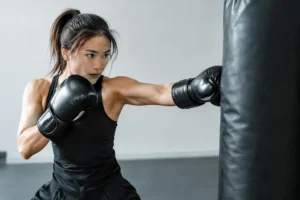
Anyone standing in front of a punching bag for the first time quickly realizes: Self-confidence doesn’t come from just telling yourself something. It arises when the body experiences that it can learn, take action, and stay calm under pressure. The best martial arts for building self-confidence, therefore, aren’t simply the toughest or most spectacular ones. They’re the ones that give you regular experiences of success, clear guidance, and a safe training environment.
Whether you’re an adult looking for more inner stability, a teenager who wants to carry yourself with more confidence, or a parent searching for a sport that instills discipline and structure in your child: martial arts can teach you much more than just punches and kicks. They demand dedication, reward patience, and show you, step by step, what you’re capable of.
What Really Builds Self-Confidence in Martial Arts
Self-confidence in training does not mean acting loud or trying to dominate others. It means being able to gauge your own personal space, clearly communicating boundaries, and remaining capable of acting even when something becomes unfamiliar or strenuous. Those who first practice a technique slowly, apply it in a controlled manner during partner training, and later recognize it in a more dynamic context develop confidence in their own perception and reactions.
The training culture is key here. A good training program does not overwhelm beginners with unnecessary intensity. It sets tasks that are challenging yet achievable. Corrections are part of the process, as are respect for training partners and adherence to the rules. People who often hold back in everyday life, in particular, benefit from taking up space, using a clear voice, and consciously guiding their bodies.
Physical progress also plays a role. Improved fitness, better posture, coordination, and strength don’t just change how you feel when moving; they often change the way you enter a room as well. This is no substitute for professional help when dealing with severe anxiety or traumatic experiences. However, as a regular practice, martial arts can be a powerful complement.
Best Martial Arts for Building Self-Confidence: Making the Right Choice
There isn’t one single discipline that works best for everyone. Some people gain self-confidence through precise forms and focused technical training, while others do so through sparring, competition, or the knowledge that they can hold their own in close-range combat. The important thing is that the training method suits your goals and your personality.
Wing Chun: Calm, Structure, and Clear Boundaries
Wing Chun is particularly well-suited for people who want to build self-confidence through body awareness, precision, and direct solutions. The system is based on an upright posture, economical movements, and clear orientation at close range. Instead of relying on brute force or acrobatic techniques, you’ll learn to make effective use of positioning, timing, and contact.
This is valuable for building self-confidence because you aren’t waiting to feel “strong enough” at some point. You practice specific techniques. Partner drills train your reaction time, focus, and ability to handle pressure. At the same time, Wing Chun requires patience: Its effectiveness lies less in flashy displays than in repeated, precise practice. Those who are willing to take the fundamentals seriously often develop a quiet, resilient confidence.
Boxing: Showing Courage and Staying Focused Under Pressure
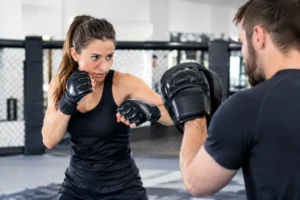
Boxing is direct, athletic, and honest. Footwork, defense, spatial awareness, and punch combinations require complete concentration. Many beginners notice within just a few weeks that they’re moving with better coordination and have a better understanding of their physical limits. This can be incredibly empowering.
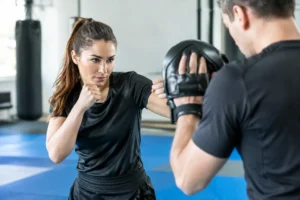
Boxing is particularly effective for building self-confidence when sparring is structured responsibly. Not everyone has to spar hard to benefit from it. Technical sparring, pad work, and controlled partner drills are enough to learn how to handle close quarters, pace, and tension. Those who realize that taking a hit isn’t the end of the world—and that they can still think clearly afterward—often carry this experience over into everyday situations.
The compromise: Boxing focuses on the hands. To gain a comprehensive understanding of self-defense, additional training is needed for other ranges and situations.
Kickboxing: Presence Through Dynamism and Stamina
Kickboxing combines punches, kicks, movement, and endurance. It’s a great choice for people who want to build self-confidence through physical performance. Practicing combinations of punches and kicks, increasing your endurance, and working on technique with a partner leads to noticeable progress.
Training can be especially helpful for young people in channeling their energy in a constructive way. Rules, personal space, and mutual respect are not secondary considerations, but rather the foundation of the training. Those who learn to act with strength while maintaining control develop not only self-assertiveness but also a sense of responsibility.
Kickboxing is demanding, though. If you haven’t exercised in a while, you should take your time and not compare yourself to the performance of more experienced training partners. Your effort counts, but improvement comes with repetition.
Grappling and BJJ: Confidence at Close Range
Many people initially find physical closeness uncomfortable or unsettling. Grappling and Brazilian Jiu-Jitsu address exactly that: they focus on clinching, takedowns, positions, control, and escapes on the ground. Because the training is very partner-oriented, you’ll learn to withstand pressure, look for solutions, and breathe calmly instead of panicking.
This boosts self-confidence in a special way. Smaller or lighter people learn that technique, positioning, and timing make a difference. At the same time, it becomes clear that there’s no magic technique that works in every situation. Strength, weight, and experience remain key factors. That’s precisely why proper training is so valuable: it instills a sense of reality rather than a false sense of security.
For people who are initially hesitant about direct contact, getting started can feel unfamiliar. A respectful team and clearly guided exercises make all the difference. No one should be pressured into situations they aren’t yet ready for.
MMA: Versatility and Realistic Problem-Solving
MMA combines striking techniques, kicks, clinching, and grappling. If you’re looking for a well-rounded workout, you’ll find plenty of opportunities here to build your confidence: You’ll learn to switch between fighting ranges and tackle a variety of challenges. The training fosters adaptability, endurance, and mental toughness.
MMA is particularly well-suited for people with a competitive spirit or a desire for competition-oriented training. For absolute beginners, however, it’s important to get the basics right. Good MMA classes don’t start off in chaos; instead, they build up each component in a way that’s easy to understand. Only once your posture, movement, and safety improve does the interplay of these elements truly make sense.
For Children and Teens: Self-Confidence Requires Guidance
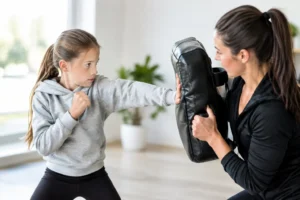
When it comes to children and adolescents, self-confidence should never be confused with aggressive behavior. Good martial arts instruction teaches that strength means protecting oneself and others. Children learn to listen, practice with focus, follow rules, and keep going after setbacks. Adolescents are given a framework in which they can test their limits without being belittled.
What matters most is the atmosphere, not the name of the sport. A child needs coaches who pay close attention, explain things clearly, and make progress visible. Small goals—such as completing an exercise with focus, learning a new sequence of movements, or training fairly with a partner—create a genuine sense of accomplishment.
A training group tailored to a specific age group also fosters a sense of community. When people see others learning alongside them, making mistakes, and supporting one another, they develop social courage. This is a value that extends far beyond the gym.
How to Find the Workout That’s Right for You
During the trial session, don’t just focus on the techniques being demonstrated. Pay attention to how people interact with one another. Are beginners taken seriously? Do the trainers explain safety rules? Is there controlled partner training instead of just random striking? Are performance goals clearly defined without embarrassing anyone?
Ask yourself honestly what you’re looking for. If you want to relieve stress and get in better physical shape, boxing or kickboxing are often great places to start. If you’re looking for structure, self-assertion, and the depth of a traditional martial art, Wing Chun might be a good fit. If you want to learn how to handle close physical contact, grappling and BJJ are valuable disciplines. If the combination of all fighting ranges appeals to you, MMA is a long-term challenge.
At Berlin Siu Lam Wing Chun Pai & SLWCP Fight Academy, tradition meets modernity: technical fundamentals, physical fitness, self-defense, and respectful interaction are not treated as opposites. This allows everyone to find a starting point that suits their own level—from their first training session all the way to ambitious athletic goals.
Self-confidence rarely grows from a single moment of courage. It grows when you keep coming back even though an exercise was difficult, when you set clear boundaries, and when you realize: I don’t have to be perfect to be able to take action. Get involved, train mindfully, and give yourself the time it takes to build real strength.