A quick jab, sharp footwork, and the ability to stay calm under pressure: Boxing teaches skills that are valuable even outside the ring. But when it comes to the question of boxing versus self-defense, it’s not about which discipline is fundamentally better. What matters is what you want to learn, in what situations you want to be able to act, and how you want to train.
If you only think about punches, you’re missing the point. Self-defense often begins long before a physical confrontation: with awareness, clear communication, maintaining distance, and the willingness to leave a situation in time. At the same time, physical skills are necessary when evasion is no longer possible. This is precisely where boxing, traditional martial arts, and modern self-defense can work together effectively.
What Boxing Really Teaches Us
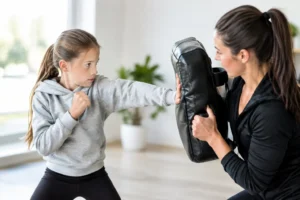
Boxing isn’t just a collection of individual punches. Good boxing training develops a sense of distance, timing, defense, coordination, and stamina. You’ll learn to move efficiently, recognize attacks, and maintain your bearings even under pressure. This is tough, honest training: repeating techniques, improving footwork, hitting the speed bags, working on the heavy bag, and practicing in a controlled manner with training partners.
Learning to handle pressure is especially valuable. In sparring, you realize how quickly a plan can fall apart when your opponent takes action. You learn to stay focused, not to overreact to hits, and still respond responsibly. This experience doesn’t make you invulnerable, but it can build self-confidence on a realistic foundation.
Boxing, however, has clear rules. It takes place primarily within striking range, in an upright position, and under athletic conditions. Low kicks, grappling, throws, ground fighting, or the question of how to break free from a hold are not part of the core of classical boxing training. Those who want to train exclusively for the ring will find a precise and demanding system. Those who want to prepare more comprehensively for unpredictable everyday situations will need additional components.
Self-defense doesn’t start with the first hit
Practical self-defense has a different goal than competition: not to win, but to get home safely. That changes the priorities. It’s about prevention, de-escalation, setting clear boundaries, and recognizing escape routes early on. Physical techniques are important, but they don’t stand alone.
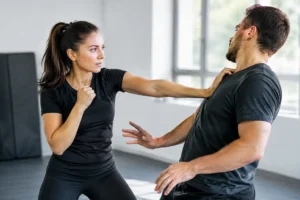
A self-defense situation can be cramped, loud, and chaotic. You might be shoved, held down, or blocked from moving out of the way by a wall. Maybe your attacker is bigger than you, maybe there are other people nearby, or maybe you can’t see everything that’s happening. That’s why self-defense training focuses not only on striking power but also on positioning, escapes, maintaining your balance, and making quick decisions.
The rule is this: A technique doesn’t work just because it looks good when you’re relaxed. Under pressure, it must be simple enough, suit your physical condition, and be practiced regularly. Simply collecting complicated sequences doesn’t mean you’ve developed reliable practical skills. A few clear principles, practiced thoroughly, are often more valuable than a large repertoire that hasn’t been put to the test under pressure.
Boxing or Self-Defense: The Key Differences
Boxing primarily trains you for a combat situation at a specific distance. Self-defense trains you to recognize danger, create distance, and, if possible, prevent or stop an escalation. Both approaches require discipline, but they raise different questions.
In boxing, a key question is: How can I move better, strike with greater precision, and protect myself from punches? In self-defense, the question is more like: How do I prevent this situation from becoming physical in the first place, and what do I do if I’m not in a good starting position?
The training culture is also different. Boxing thrives on clearly defined rounds, repetitions, and the ability to compare performance across athletes. Self-defense, on the other hand, more often involves scenarios, verbal communication, disadvantageous positions, and varying distances. Both can be intense. Both require respect for your training partner. And both lose their value when safety and a controlled progression are lacking.
This distinction is particularly relevant for children and adolescents. They don’t need to be afraid of the world; rather, they need the confidence to act. Training should teach them to clearly set boundaries, seek help, avoid resolving conflicts through violence, and be able to defend themselves physically if necessary. Discipline here does not mean blind obedience, but rather taking responsibility for oneself and others.
Why Connection Is Often the Stronger Path
Those who combine boxing with self-defense principles benefit from two perspectives. Boxing improves movement quality, timing, stamina, and experience with active resistance. Self-defense complements this by developing an awareness of prevention, close-range combat, escapes, the surrounding environment, and escape routes.
A holistic training program can also incorporate elements from Wing Chun, kickboxing, grappling, and MMA—not to list as many styles as possible, but because conflicts know no stylistic boundaries. A good school teaches tools and principles: maintaining a stable stance, understanding distance, using force effectively, thinking clearly under pressure, and acting responsibly.
Tradition meets modernity when the cultural depth of a martial art is not treated as mere decoration, but shapes one’s attitude. Respect, patience, and self-control are just as much a part of training as pad work, sparring, and realistic self-defense exercises. The focus is on the individual: their goals, their abilities, and their pace.
Which workout is right for your goal?
If you’re looking for a physical challenge, want to improve your fitness, and learn how to throw clean punches, boxing is an excellent place to start. You’ll quickly realize just how much concentration goes into even simple movements. Beginners, in particular, benefit from the clear structure and the visible progress they make in endurance, coordination, and body control.
If your focus is on everyday safety, your training should include more than just striking techniques. Make sure it covers de-escalation, distance management, escapes, and how to behave under stress. Good self-defense isn’t about showing off. It teaches you that the best physical confrontation is the one that never happens.
If you want to learn how to fight over the long term and develop yourself in a well-rounded way, joining a club makes a lot of sense. At the Berlin Siu Lam Wing Chun Pai & SLWCP Fight Academy, adults, teens, and children can explore different areas within a structured framework. This way, you don’t have to commit to a specific path too early, but can discover which form of training challenges you and helps you progress.
The quality of the instruction is also important. Are beginners taken seriously? Is there controlled contact rather than unnecessary roughness? Do advanced students learn to take responsibility? A rigorous training program may be demanding, but it requires clear rules, good guidance, and a community that fosters growth.
The first step: exercise regularly
The decision doesn’t have to be final. Many people start boxing because they’re looking for exercise and technical training, and later discover an interest in self-defense, grappling, or traditional martial arts. Others come for self-defense and realize they love the athletic challenge.
What matters isn’t whether you already know exactly where your path is leading on the very first day. Get involved, train with focus, and give yourself time. With every clean repetition, every controlled lap, and every respectful exchange, not only does your technique improve, but so does your ability to stay centered in difficult moments.