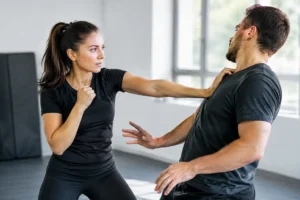
After the third round on the punching bag, it becomes clear what sets martial arts fitness training apart from a regular workout: It’s not just about working your muscles. Breathing, posture, reaction time, and concentration all have to come together, even when your legs start to feel heavy. That’s exactly where the kind of fitness that carries over into everyday life comes from—when climbing stairs, under stress, and in situations where you want to trust yourself.
Martial arts aren’t a shortcut to quick results. They require regular practice, proper technique, and a willingness to push your limits. In return, you’ll get more than just a higher heart rate: you’ll develop body control, resilience, and a better sense of what you’re capable of.
What Martial Arts Fitness Training Really Works
Many people start working out because they want to get in better shape, lose weight, or find a way to balance out sitting at an office desk. These are valid goals. However, as you train, it quickly becomes clear that strength without coordination is of little use, endurance without proper form is inefficient, and speed without control leads to frantic movements.
Martial arts fitness training combines these skills. In boxing or kickboxing, you train endurance, footwork, striking power, and spatial awareness. In grappling and MMA, you also develop core stability, balance, and the ability to act with control under intense pressure. Wing Chun and Shaolin Kung Fu cultivate structure, timing, precision, and a vigilant mindset. Chi Kung can complement these practices by promoting conscious breathing, flexibility, and recovery.
The main difference from a traditional circuit training routine lies in the purpose of each exercise. A push-up can build strength. If you then throw clean punches from a stable guard, keep your shoulders relaxed, and return to the starting position, that strength becomes functional. You learn to use it in a targeted way.
Fitness requires technique, not just toughness
If you’re just starting out in martial arts, you don’t have to be particularly flexible, strong, or have a lot of stamina right away. The key is to make sure the intensity matches your current level. A good start involves the basic stance, footwork, simple punching and kicking movements, and a stable core. Only once this foundation is solid do the pace, complexity, and resistance increase.
Hardness alone is not a measure of quality. If you’re constantly tense during training, try to avoid every hit, or force movements with brute strength, you’ll waste energy unnecessarily and increase your risk of injury. Controlled training is no less demanding. It’s essential for ensuring that you can train for a long time, stay focused, and make visible progress.
From the warm-up to the final lap
A well-structured session gradually prepares the body for physical exertion. Joint mobilization, light running and coordination exercises, as well as core and posture exercises, prepare the body for the techniques. This is followed by drills: combinations on the pad, partner exercises, takedown setups, or movement sequences that are repeated precisely over and over again.
The high-intensity phase can take many different forms. Sometimes it focuses on interval training with the punching bag; other times, it involves controlled sparring, wrestling, or a challenging form practice. Not every session has to leave you completely exhausted. A technically sound session in which you understand and master new movements can be more valuable for your development than a workout that focuses solely on maximum fatigue.
Finally, gentle movements, breathing, and stretching help the body wind down. Recovery doesn’t start the next day—it’s part of the workout itself.
Which martial arts are right for your goals
The question isn’t just: Which martial art is the best? More importantly: What do you want to develop, and which form of training will keep you motivated in the long run? If you want to train with a focus on striking and really push your endurance, boxing and kickboxing offer a direct path. The intensity is high, the feedback is immediate, and you’ll quickly notice improvements in your rhythm, defense, and endurance.
Wing Chun places greater emphasis on structure, distance, reflexes, and working in confined spaces. This traditional martial art is not merely a form of fitness; rather, it demands concentration and continuous technical training. Shaolin Kung Fu combines dynamic movements, strength, flexibility, and forms with a cultural depth that stays with many practitioners for years.
Grappling and MMA are especially helpful if you want to understand what happens when you lose distance. Here, you’ll learn how to break your opponent’s balance, control positions, fall safely, and handle pressure. It’s physically intense and mentally enlightening because solutions don’t come from strength alone.
When it comes to practical self-defense, what matters is that techniques are practiced under realistic conditions: making clear decisions, staying aware of one’s surroundings, de-escalating situations, and performing simple, reliable movements. Physical fitness supports self-defense, but it is no substitute for good judgment or responsible behavior.
How to Get Started with Your Workout
The first step isn’t a fitness test. Come in comfortable workout clothes, bring plenty of water, and be ready to ask questions. A trial session will show you how the group works, how the coaches provide feedback, and whether the atmosphere is a good fit for you. In a good training community, beginners are taken seriously without being overwhelmed.
Be open about any injuries, pre-existing conditions, or extended breaks from training. This isn’t a sign of weakness—it’s the foundation for effective exercise management. Especially when it comes to knee, back, or shoulder issues, exercises can be adapted so you don’t just have to sit on the sidelines. Professional guidance ensures safety while still challenging you.
Set a specific goal for the first few weeks: show up regularly, learn a stable starting position, or stay focused for one more round. Not all progress shows up on the scale. Maybe you’ll feel calmer, your posture will improve, or you’ll recover faster between rounds. These changes are real results of your training.
Martial Arts Fitness for Children, Teens, and Adults
Children don’t need training that turns them into little adults at an early age. They need physical activity, clear rules, age-appropriate challenges, and an environment where respect is valued. Martial arts can promote coordination, self-confidence, and concentration when educational guidance and safety are the top priorities. Winning and losing are part of the experience, but they do not define a child’s worth.
Teenagers benefit greatly from a space where effort is recognized. They learn that discipline does not mean rigid obedience, but rather reliability toward themselves and the group. In controlled partner training, an important sense of respect also develops: If you want to be strong, you must learn to take responsibility for your own strength.
Adults come from very different backgrounds. Some are looking to get back into sports after years of inactivity, while others want to prepare for competitions or improve their self-defense skills. At Berlin Siu Lam Wing Chun Pai & SLWCP Fight Academy, traditional systems meet modern martial arts methods, ensuring that training remains adaptable to individual needs. The focus is on the individual, but it’s your commitment that counts.
Progress happens between training sessions
For many people, two to three regular workouts per week provide a good framework for building fitness and mastering technique. Even if you can only work out once a week, you should still get started. Consistency beats the perfect plan that falls apart after ten days.
Outside of training, make sure to get enough sleep, eat a balanced diet, and stay active in your daily life. After very intense sparring, strength training, or grappling sessions, your body needs time to recover. Sore muscles aren’t a reliable indicator of training quality. If the pain becomes sharp, your joints feel unstable, or you’re exhausted for days on end, it’s wiser to take a break or seek professional advice than to push through it.
Make sure to track even your small progress. Which combination are you able to perform more smoothly? How long can you stay calm during a challenging round? When was the last time you made a correction instead of getting frustrated? Martial arts don’t just shape your body; they also train the mindset with which you face challenges.
Get involved without having to prove yourself. With good guidance, respectful training partners, and consistent effort, that first grueling workout will gradually turn into a strength you can count on.