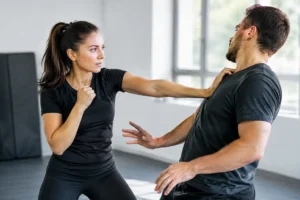
Three minutes on the punching pads can reveal more than a whole month of theory: How does your body respond under pressure? Do you stay calm as distance, speed, and resistance increase? A martial arts workshop in Berlin is the perfect opportunity to train for exactly that in a focused setting—with clear instruction, dedicated partners, and a goal that goes beyond simply working up a sweat.
Workshops aren’t a shortcut to a black belt. But they can provide a crucial boost: finally understanding a technique, overcoming inhibitions in sparring, honestly assessing your own fitness level, or getting acquainted with a new discipline like grappling, kickboxing, or self-defense. Those who participate with respect often make tangible progress in just a few hours.
What Makes a Martial Arts Workshop in Berlin Valuable
The biggest difference from a regular class lies in the focus. While regular training builds skills over months and years, a workshop is dedicated to a clearly defined topic. This could include boxing punching techniques, handling kicks and distances, escaping from holds, breakfalls, ground fighting, or combining traditional Wing Chun principles with modern combat practice.
This focus creates room for attention to detail. Instead of just seeing a technique once, you repeat it under different conditions: slowly and precisely, with a cooperative partner, using pad work, or with controlled resistance. Only then does it become clear whether your footwork, guard, timing, and breathing are truly working together.
A good workshop, therefore, does not focus on teaching as many spectacular techniques as possible. It teaches principles that last. Those who learn to better gauge distance, protect their center, and remain capable of acting under pressure can apply this knowledge to many areas of training.
One topic, one goal, a logical structure
A professionally led workshop doesn’t start with wild sparring. First, participants prepare their bodies and focus. Mobility, stability, core tension, and coordinated movements ensure that all participants can safely get into the training. After that, the basics are explained and demonstrated before the intensity and complexity increase.
Technology must work under pressure
Extending your fist straight out is easy. Striking in a straight line while keeping your shoulder protected, maintaining a stable stance, and dealing with a moving opponent is another matter entirely. This is precisely where the value of a good martial arts program lies: technique is not treated as rigid choreography, but as a tool for real-life situations.
Depending on the topic, this might mean linking strike sequences on the punching pads, intercepting attacks, working at close range, or breaking out of a clinch in a controlled manner. In grappling, the focus might be on understanding positions, distributing pressure correctly, and avoiding frantic power struggles. In self-defense, the focus is on awareness, clear boundaries, de-escalation, and simple, reliable actions.
Not every exercise requires full contact. On the contrary: controlled training is often the faster way to better technique. Resistance is increased gradually once your posture, awareness of your partner, and form are correct. This way, you can train boldly without becoming reckless.
Build Stamina the Smart Way
A workshop is supposed to be challenging. Sweat, heavy legs, and burning shoulders are all part of the experience when you’re working on pad drills or doing rounds with partner switches. But sheer exhaustion isn’t a sign of quality. The intensity should always be appropriate for the learning objective.
If form breaks down after ten repetitions, that doesn’t necessarily mean you need to increase the pace. Perhaps you need to correct your posture, breathe better, or make a shorter, more precise movement. Good trainers recognize this difference. They demand effort without pushing participants into sloppy movement patterns.
Safety is part of martial arts
Martial arts require trust. You need to be able to count on your partner to train with self-control, respect stop signals, and not demonstrate their skills at the expense of others. That’s why clear rules, appropriate protective gear, and attentive instruction are essential to any serious workshop.
Especially during sparring, throws, joint locks, and ground fighting, the atmosphere is key to learning success. Ego has no place on the mat. Those who constantly want to win rarely learn to listen. On the other hand, those who stay focused, accept feedback, and protect their partner develop more quickly and contribute to a strong training community.
Previous experience, fitness level, and injuries must also be taken into account. A beginner should not have to cope with the same level of pressure as someone with years of competitive experience. Conversely, advanced participants need challenging tasks that help them improve both technically and mentally. Good group leadership achieves both without excluding anyone.
Who is a martial arts workshop in Berlin suitable for?
For adults, a workshop can serve as an introduction to regular training or a deliberate complement to their existing sport. Those who have been jogging, doing strength training, or playing team sports often find that martial arts offer a new form of concentration: the whole body is engaged, but at the same time, the mind must process distance, rhythm, and decisions.
Teenagers benefit greatly from a clear framework. They learn not to let their energy run wild, but to channel it into technique, posture, and respectful interaction. Self-confidence arises not from grand words, but from experiencing competence: mastering a task, moving forward after a mistake, helping a partner, and feeling one’s own growth.
For children, the focus is on age-appropriate physical activity, coordination, attention, and social rules. A children’s workshop must be playful enough to spark enjoyment and structured enough to help children experience values such as respect, concentration, and consideration. Full-contact activities and overwhelming scenarios have no place there.
Experienced martial artists, on the other hand, can specifically broaden their horizons. A boxer gains new perspectives in the clinch or at close range. Those with a background in traditional Kung Fu can test their techniques against moving opponents. A grappler learns how distance and the threat of strikes alter decision-making on the ground. Tradition and modernity meet not as a catchphrase, but in practical application.
Choose the Right Workshop
Don’t start by asking if a workshop sounds particularly tough. Ask if the topic aligns with your goal. Do you want to feel more confident, work specifically on striking power, gain your first experience in sparring, or improve your ground skills? A clearly defined goal is a good sign.
Also, pay attention to how safety and differences in skill level are handled. Are beginners taken seriously? Are technical explanations provided instead of mere commands? Is it clear that the instructor has both combat experience and a knack for teaching? Especially in a city with so many options, this level of care is what distinguishes a meaningful workshop from a loud, one-time event.
Group size also plays a role. Smaller groups allow for more individual feedback. Larger groups can generate motivational energy and offer a variety of training partners. Which is better depends on the topic. For complex joint locks, self-defense, or beginner classes, personalized instruction is especially valuable. For pad work or conditioning circuits, a larger group can work well as long as the structure remains clear.
From a Workshop to Regular Training
An intense day can spark enthusiasm, but progress requires repetition. So the most meaningful question to ask after a workshop isn’t, “What did I learn today?” but rather, “What will I focus on practicing more consciously next week?” Maybe it’s your guard, a clean basic stance, calmer breathing, or the willingness to allow controlled contact.
Jot down one or two specific points and incorporate them into your next training session. Small improvements, when reviewed regularly, have a greater impact on your technique and self-confidence than occasional feats of strength. Those who train consistently not only develop faster hands or greater endurance, but also patience, resilience, and a realistic assessment of their own abilities.
At Berlin Siu Lam Wing Chun Pai & SLWCP Fight Academy, the focus is on the individual: traditional martial arts, modern training methods, and practical self-defense are seamlessly integrated, without losing sight of each person’s individual journey.
Get involved, ask questions, and train with an open mind. The best workshop isn’t the one where you just go home exhausted, but the one where you step onto the mat more mindfully, confidently, and determinedly at your next training session.