A clean punch, a kick delivered from the right distance, and a controlled throw can decide who controls the action in just a few seconds. It is precisely this combination that makes Sanshou boxing training so challenging and versatile. It’s not about attacking as wildly as possible. It’s about staying focused under pressure, combining techniques effectively, and using your body strategically.
Sanshou, often called Sanda, is a Chinese full-contact sport with a clearly defined competition structure. It combines the punching and kicking techniques of Kung Fu with throws, sweeps, and positional battles. For many practitioners, that’s the appeal: You don’t just learn individual techniques, but you come to understand how distance, timing, movement, and control all work together.
What Sets Sanshou Apart from Classical Boxing
In traditional boxing, the focus is on hand techniques, footwork, defense, and punch combinations. Sanshou builds on these fundamentals but significantly expands them. In addition to jabs, hooks, and uppercuts, it incorporates kicks, knee strikes (depending on the rules), as well as throws and sweeps. So when defending against an attack, a fighter can not only strike back but also disrupt their opponent’s balance and bring them to the ground in a controlled manner.
This changes how you manage distance. A boxer is careful not to walk into a punch. In Sanshou, you also have to block kicks, prevent throws, and regain your ability to act after coming out of a clinch. The challenge isn’t about having the longest list of techniques possible. The key is to practice a few reliable movements so often that you can still execute them even under intense pressure.
Here, tradition meets modernity. Chinese martial arts provide principles such as structure, body mechanics, and precise movement patterns. Modern training methods ensure that these principles are effectively applied in partner drills, sparring, and, when appropriate, competition. This makes Sanshou appealing to people who seek practical combat experience without losing sight of the depth of martial arts.
Sanshou boxing training begins with control
A good training session doesn’t start with intense sparring. If you try to overwhelm your opponents right away, you’ll neglect your technique and increase your risk of injury. First, you’ll work on your stance, guard, footwork, and sense of distance. You’ll learn to stand firmly, stay agile, and return to a safe position after every attack.
The connection between the upper and lower body is particularly important. A strike loses its effectiveness if the feet aren’t working together. A kick becomes slow and predictable if the hips and supporting leg aren’t properly aligned. The same applies to throws: Power helps, but good timing and a shifted center of balance are more effective than simply pulling or pushing.
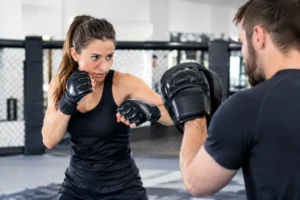
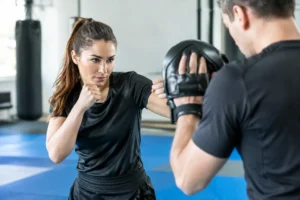
Partner drills put these fundamentals into motion. First, one person works with clear instructions, such as a simple combination of a punch and a kick. The other person practices maintaining distance, defending, and responding appropriately. Only once both sides can control the sequences is the pace increased. This way, self-confidence grows on a solid foundation rather than on false bravado.
The Four Areas of Training
Sanshou requires a well-rounded physique. Those who train only strikes become unstable when kicking. Those who practice only throws often remain too passive at a distance. That is why training should combine these different areas:
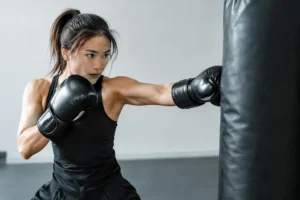
- Striking techniques: straight punches, hooks, combinations, defensive work, and the transition between offense and defense.
- Kicking techniques: front kicks, roundhouse kicks, side kicks, and the ability to safely return to a fighting stance after a kick.
- Throws and Sweeps: Using pull, pressure, angle, and timing to control your partner’s balance.
- Fitness and athleticism: explosiveness, core stability, flexibility, and the endurance to perform cleanly even in the later rounds.
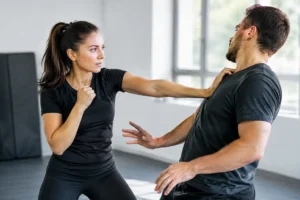
These areas are not isolated from one another. Here’s an example: You attack with a combination of strikes, force your opponent to defend, follow up with a kick, and use their reaction to set up a controlled throw. Not every combination works for every body type or situation. Taller practitioners often work at a distance differently than smaller, faster fighters. That’s why guidance, correction, and a willingness to develop your own style step by step are essential.
Sparring: A Clear Framework Instead of a Test of Ego
Sparring is a valuable part of Sanshou, but it is not a test of who is the toughest in training. Good sparring has a purpose. Sometimes the focus is on distance and footwork, sometimes on defending against kicks, and sometimes on transitioning from an exchange of strikes to a throw. Through such exercises, a chaotic exchange of strikes becomes a learning opportunity.
Intensity is beneficial when technique, protection, and mutual respect develop alongside it. Protective gear, agreed-upon rules, and coach supervision create the framework in which even beginners can learn to handle physical contact. Those who have never sparred before don’t have to fight full rounds right away. Technical sparring at a reduced pace often teaches more than an uncontrolled exchange.
Experienced athletes also benefit from this approach. They can focus specifically on changes in rhythm, counterattacks, ring control, or competition tactics. Hardness alone doesn’t make anyone better technically. The ability to challenge a partner confidently while supporting their development demonstrates true maturity in martial arts.
Who is Sanshou suitable for?
Sanshou isn’t just a sport for people with competitive ambitions. Adult beginners will find it a challenging way to build fitness, coordination, and self-confidence. Those who train after a long day at work benefit from the focus it provides: During training, what matters are breathing, posture, reaction time, and the next precise move. Your mind clears because the task at hand is specific.
For young people, Sanshou can be a powerful learning experience. They come to understand that discipline does not mean standing still, but rather being reliable in how they treat themselves and others. They learn to respect boundaries, take responsibility for their own strength, and keep working even after making mistakes. Especially in a safe, pedagogically guided environment, martial arts become more than just exercise.
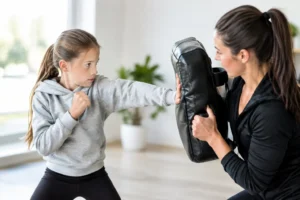
Children, on the other hand, have different priorities than adults. For them, the focus is on basic coordination skills, age-appropriate partner exercises, attention, and the joy of movement. Full-contact play and complex competitive situations are not the starting point. Good instruction adapts the level of challenge, intensity, and content to the child’s stage of development.
Don’t confuse self-defense with competition
Sanshou develops skills that are valuable for self-defense: recognizing distance, handling stress, maintaining one’s balance, and acting decisively. Nevertheless, competitive sports do not automatically equate to self-defense. In the ring, there are rules, protective gear, weight classes, and a controlled environment. Outside of that, escape, de-escalation, and staying alert may be the better choices.
That is precisely why Sanshou complements practical self-defense so well. Physical skills are developed under pressure, while self-defense also takes into account behavior, perception, and legal responsibility. Those who train in both do not learn to seek out conflicts. They learn not to feel helpless and to assess risks more realistically.
Progress happens between rounds
The most visible progress rarely comes from a single intense session. It happens when you show up regularly, take feedback to heart, and pay attention to the small details. A guard that resets after every combination. A kick that doesn’t throw you off balance. A throw that ends in a controlled manner. These things seem unspectacular until they suddenly work reliably during sparring.
At the Berlin Siu Lam Wing Chun Pai & SLWCP Fight Academy, the focus is on the individual. Different levels of prior experience, goals, and physical abilities don’t call for shortcuts, but rather a clear training path. Beginners are encouraged to ask questions and make mistakes. Advanced students are given exercises that help them improve both technically and mentally.
Get involved, but be patient with your progress. In Sanshou, strength doesn’t come from making a big show of yourself, but from mindful training, respectful partners, and the courage to fight a little cleaner in every session than you did before.