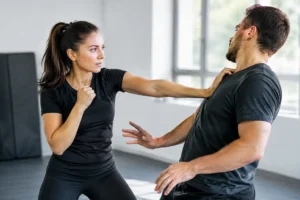
A conflict doesn’t care whether you’re in good shape, have won a trophy, or can run a perfect race. It demands attention, composure, and the ability to act sensibly under stress. That’s exactly why the question of self-defense versus martial arts can’t be answered with a simple “either/or.” Those who want to become safer, more resilient, and better able to take action in the long run often benefit from understanding both perspectives.
Self-Defense or Martial Arts: The Difference
Self-defense has a clear goal: to recognize danger as early as possible, avoid conflicts, and protect yourself when there is no other option. This involves more than just techniques. Crucial factors include maintaining a safe distance, body language, staying alert in public spaces, and being willing to seek help in time or walk away. The best physical confrontation is always the one that doesn’t have to happen.
Martial arts continue. Through regular training, you’ll develop timing, coordination, strength, endurance, and the ability to handle pressure. You’ll learn not only to understand punches, kicks, throws, and ground control in theory, but also to apply them in a controlled manner against training partners. Competition can be a goal, but it doesn’t have to be.
So the difference lies primarily in the context. Self-defense focuses on unpredictable everyday situations and de-escalation. Martial arts rely on rules, protective gear, and repetition. That doesn’t make them unrealistic—quite the opposite. It is precisely this safe, consistent practice that builds skills that can be drawn upon under pressure.
Why Technology Alone Isn’t Enough
A single escape move or a quick combination of strikes sounds impressive. Under stress, however, everything changes: breathing becomes shallower, fine motor skills deteriorate, perception narrows, and decisions must be made in a matter of seconds. Anyone who relies on a supposed secret technique is building on an unstable foundation.
Effective self-defense skills develop through simple, resilient movements. Maintaining a stable stance, creating distance, communicating clearly, breaking free from a hold, protecting your head, and finding a safe way out: these are skills that must be repeated and tested under controlled resistance.
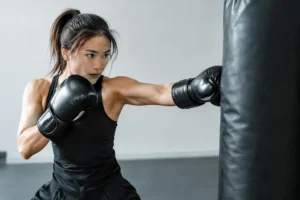
This is where the connection to martial arts comes in. Boxing, for example, teaches distance, defense, and footwork. Kickboxing expands your understanding of kicks and punch combinations. Grappling teaches you what physical contact, balance, and control feel like. Wing Chun focuses on structure, close-range combat, and dealing directly with pressure. No single discipline can solve every situation. Together, however, they provide a broader understanding of movement and the dynamics of conflict.
Martial arts shape one’s posture, not just physical fitness
Many people start out for self-defense and stick with it because of the changes they notice in their daily lives. They stand taller, react with less panic, and have a better understanding of what their bodies are capable of. This isn’t the result of empty slogans, but of regular training.
Traditional martial arts offer an important value: discipline. Discipline does not mean harshness for its own sake. It means training consistently, treating partners with respect, and taking one’s own development seriously. Those who learn to strike with control also learn to take responsibility for their own strength.
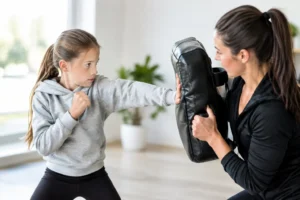
This framework is especially valuable for children and teens. They don’t need stories about invincible fighters; instead, they need clear rules, physical activity, a sense of accomplishment, and adults who explain boundaries in a way they can understand. Age-appropriate training builds concentration, self-confidence, and social skills—without turning martial arts training into a platform for violence.
What fits your goal?
If you’re feeling uncertain after a specific incident or want to quickly build a foundation for everyday life, a practical self-defense workshop can be a good place to start. You’ll learn to assess situations, set clear boundaries, and practice simple responses. However, this is no substitute for long-term physical training.
If you want to get in better shape, develop a true understanding of movement, and stay calm even under pressure, consistent martial arts training is the strongest foundation. Progress doesn’t happen after a single session. It comes from developing your footwork, technique, strength, and mental endurance over weeks and months.
Maybe you’re drawn to the cultural depth of Chinese martial arts. Maybe you want to box, wrestle, or eventually compete in MMA. Maybe you’re just looking for a place where you can train with focus after work and become part of a supportive community. Your goal may change. What matters most is that the training is neither too demanding nor too easy for you.
For Beginners: Start with the Basics, Then Specialize
You don’t have to make a final decision right away. Good training starts by teaching you the fundamentals that are useful in many areas: posture, breathing, coordination, techniques for falling and moving, spatial awareness, and treating your partners with respect. After that, it will become clearer which direction challenges and motivates you the most.
Pay attention to whether you can ask questions during training, whether the exercises are explained clearly, and whether different skill levels are taken into account. A beginner doesn’t need proof that others are further along. They need an environment that challenges them, guides them safely, and makes their progress visible.
For Advanced Learners: Practicing Honest Communication
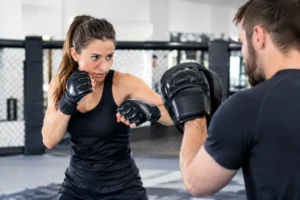
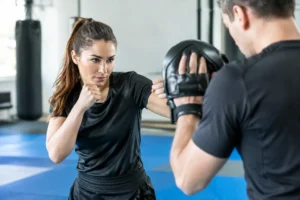
Those who already have experience shouldn’t just focus on learning new techniques. What really matters is whether your own technique works when faced with resistance. Controlled sparring, pad work, clinching, wrestling, and situational self-defense drills honestly reveal where you still lack timing, stamina, or decision-making skills.
Keep in mind: Hard training does not mean reckless training. Good partners help each other improve. They train intensely, stick to their agreements, and look out for one another. This culture is what distinguishes a serious academy from a place where ego is more important than growth.
Security begins before the first contact
Self-defense is often understood too narrowly as a physical reaction. But self-protection begins much earlier: with awareness, clear boundaries, and a realistic assessment of one’s own capabilities. If you can leave a threatening situation, you should leave it. If you can organize support, you should do so. Physical resistance is neither a test of courage nor a sporting contest.
Proportionality is also important from both a legal and moral standpoint. The goal is protection, not punishment. That is why responsible training always includes the ability to step back after taking action, seek help, and avoid further escalating the situation.
Tradition Meets Modernity in Training
A contemporary training program does not have to force a false choice between tradition and modern application. Traditional systems preserve principles, training methods, and a mindset that have been developed over generations. Modern martial arts contribute proven training methods, athletic conditioning, and honest feedback from sparring and competition.
At Berlin Siu Lam Wing Chun Pai & SLWCP Fight Academy, we combine these approaches: Siu Lam Wing Chun and Shaolin Kung Fu meet boxing, kickboxing, grappling, MMA, and practical self-defense. The individual is at the center of everything we do. That’s why not everyone trains the same way—but everyone needs clear standards, dedicated guidance, and a safe environment.
A trial class isn’t a test you have to pass. It’s your chance to see if the atmosphere, the training style, and the people are a good fit for you. Come in comfortable workout clothes, be open to new movements, and give yourself more than one session to try it out. Your effort counts, but progress takes patience.
You don’t have to wait until you feel ready. Readiness often comes the moment you take your first step onto the workout area.