Anyone who has to defend themselves in a threatening situation doesn’t have time to think about complicated sequences of movements. Good self-defense courses therefore do not prepare students for a choreographed test, but rather for making clear decisions under stress: creating distance, setting boundaries, recognizing danger, and protecting oneself decisively. This is precisely the difference between merely learning techniques and training that enables you to act effectively in an emergency.
Self-defense doesn’t start with the first blow. It begins with awareness, posture, and the willingness to remove yourself from a situation early on. Physical techniques are important—but they work better when they’re embedded in a comprehensive understanding of safety, movement, and mental strength.
What Self-Defense Really Needs to Achieve
Many people seek out training because they want to feel more confident, get in better shape, or regain trust in their own bodies after a bad experience. These motivations vary, but a reputable course should take them all seriously. It’s not about training yourself to be afraid. It’s about strengthening your ability to take action.
Practical self-defense teaches how conflicts can arise and how to defuse them as early as possible. This includes being alert to your surroundings, using clear body language, and using your voice effectively. Being able to say “no” clearly, demand personal space, and set boundaries can take the edge off many situations.
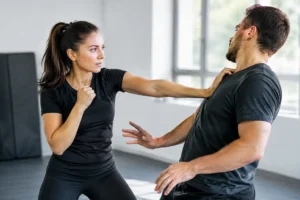
When a physical confrontation can no longer be avoided, simple, reliable movements are essential. An effective approach focuses not on spectacular techniques, but on principles: a stable stance, protecting the head, moving to create distance, escaping from holds, and targeted, proportionate self-defense. Under stress, there is rarely room for perfection. You must train to perform actions that can still be executed even when you’re flooded with adrenaline, in a confined space, and feeling uncertain.
Good self-defense classes combine practical training and mindset
A course isn’t automatically good just because it looks challenging. Nor is it enough to practice movements slowly and without resistance. What matters most is striking a balance between safety, technical difficulty, and realistic training.
Beginners first need an environment where they can ask questions, make mistakes, and develop movements at their own pace. At the same time, training must remain challenging. Partner drills, controlled resistance, and realistic scenarios reveal whether a technique has truly been mastered. This doesn’t mean that every session turns into full-contact training. It means that the intensity is increased in a meaningful way.
Professional instruction also explains the legal and ethical boundaries. Self-defense is not a license to use violence. The goal is always to prevent harm and to extricate oneself from danger. Those who train therefore learn responsibility: for their own actions, for their training partners, and for the situation as a whole.
This attitude fosters a sense of security during training and clarity outside the training area. Respect is not merely a gentle complement to fighting, but a prerequisite for people to learn seriously and over the long term.
Tradition Meets Modernity
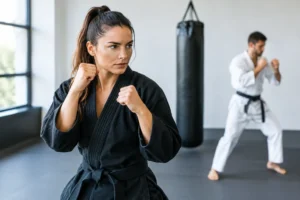
Traditional martial arts can make a valuable contribution to self-defense. Systems such as Wing Chun develop structure, a sense of distance, coordination, reaction time, and close-range combat skills. They require concentration and teach that technique does not come from strength alone, but from body mechanics, timing, and consistent practice.
However, no single style, taken as a rigid concept, is sufficient for comprehensive self-defense. Those who can move effectively at various distances are better prepared. Boxing and kickboxing, for example, improve footwork, defense, and striking range. Grappling teaches how to handle holds, clinches, and ground situations. MMA-oriented elements help you understand the transitions between these areas.
“Tradition meets modernity” therefore does not mean indiscriminately collecting techniques. It means combining meaningful methods in a way that allows them to complement one another. The cultural depth and discipline of traditional martial arts are preserved, while modern training methods teach how to apply these skills under pressure. For many adults, it is precisely this combination that is compelling: They want more than just fitness, but they don’t want empty promises.
Which course format is right for you?
The right class depends on your initial goal. If you’re looking to reintroduce exercise into your daily routine after a long break from sports, you’ll need a different starting point than someone who already has martial arts experience or is specifically pursuing competitive goals.
For adults, regular group training is often the most effective foundation. It combines technique, fitness, coordination, and partner work. The consistent training schedule makes progress visible and fosters a sense of commitment. Especially when the goal is to build self-confidence, consistency is more important than a single intensive workshop.
Workshops can still be useful, however, especially when they focus on a specific topic: self-defense in everyday life, escaping from holds, how to behave in conflict situations, or the basics of defending against punches and kicks. They provide a concentrated boost. However, lasting confidence comes from repetition and from trainers who guide your development over weeks and months.
Teens benefit particularly from courses that combine clear rules with real responsibility. They want to be active, test their limits, and be taken seriously. At the same time, they need a structure in which impulsiveness is not rewarded but guided. Good training enhances concentration, frustration tolerance, and respectful interaction with one another.
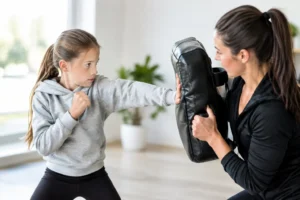
For children, the focus is even more on playful movement, coordination, and safe boundaries. Children’s classes should not be scaled-down versions of adult self-defense. Teaching experience, age-appropriate exercises, and a positive group atmosphere are key to whether children develop self-confidence without being overwhelmed.
Here’s what you should keep in mind during your trial workout
A trial workout isn’t just a chance to check out the facilities. It’s an opportunity to assess the quality of the instruction and the team atmosphere. Observe whether the trainers explain things clearly and adapt to different skill levels. Are new members guided or simply thrown into the workout? Are there clear rules for partner exercises, and is safety a priority?
Also pay attention to the group. A performance-oriented training culture can be motivating if it’s grounded in respect. No one has to prove how tough they are on their first visit. What matters is whether advanced participants take on responsibility, whether training is conducted in a controlled manner, and whether effort is valued without anyone being humiliated.
Feel free to ask about the structure of the training. Does it combine fitness, technique, practical application, and mental aspects? Are there opportunities to explore different distances and training focuses? A good school can explain why it uses certain methods—and where their limitations lie.
At Berlin Siu Lam Wing Chun Pai & SLWCP Fight Academy, this holistic development is the focus: traditional martial arts, modern combat sports methods, and practical self-defense are taught by a team that brings together professional, educational, and physical therapy perspectives. The focus is on the individual, not on quick self-promotion.
Progress is not only reflected in technology
Many people expect to feel more confident after just a few sessions. The first changes often do come quickly: better posture, improved stamina, greater awareness of personal space, and a clearer understanding of boundaries. Deeper progress, however, takes time. The ability to stay calm under stress, execute movements with precision, and react appropriately grows with every controlled repetition.
That’s not a drawback—it’s the strength of serious training. Self-defense isn’t a trick you learn once and then master. It’s a skill that needs to be cultivated—physically, mentally, and through interaction with others.
Get involved, but don’t set unrealistic standards for yourself. The right course challenges you without overwhelming you. It gives you tools for everyday life and a place where discipline, respect, and shared growth are not just talked about, but practiced.